
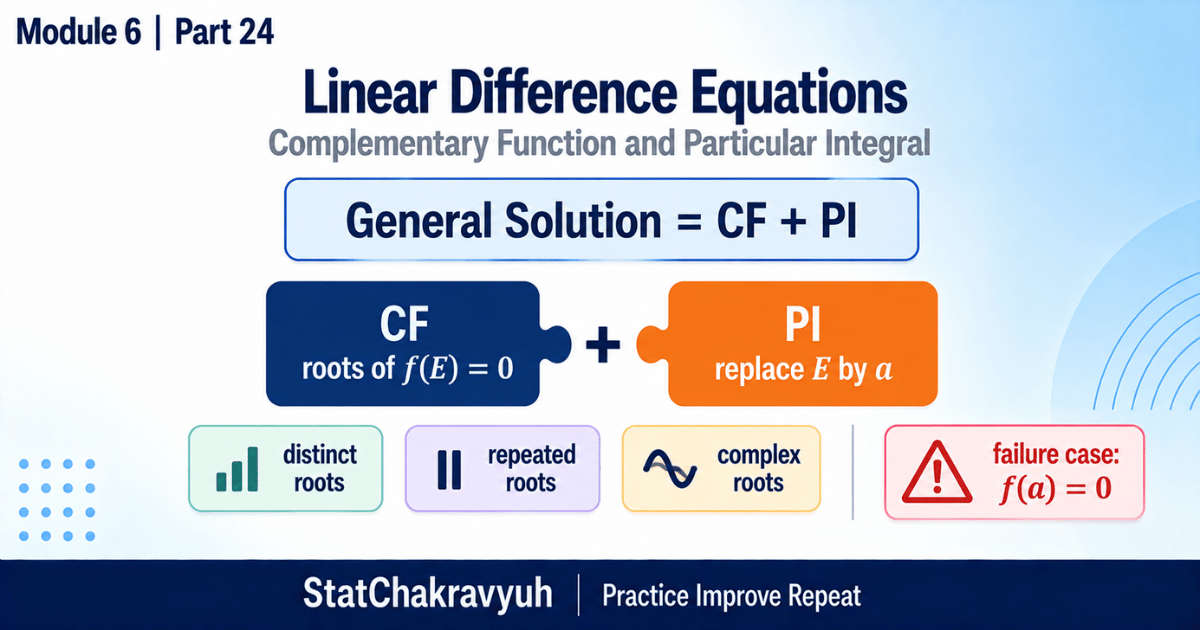
Welcome back to Part 24 of Module 6, updated for the UPSC ISS 2026 to 2027 cycle. Part 23 handled systems where today depends only on yesterday. Real data often looks back two or three steps and absorbs an external growth force on top. The tool for those systems is the Linear Difference Equation with Constant Coefficients, solved by the Complementary Function plus Particular Integral method. If you have studied differential equations, this topic will feel like meeting an old friend in discrete clothing.
In operator form the equation reads , and the general solution is always CF plus PI. The CF comes from the roots of the auxiliary equation through three cases, and the PI of an exponential right side follows the shortcut .
Exam context: 80 questions, 200 marks, 2 hours, 2.5 marks per question, about 0.83 deducted per wrong answer. CF and PI questions are pure pattern matching, typically finished inside 30 of the roughly 90 seconds each question affords.
This post is Part 24 of the Summation of Series and Difference Equations Guide (Module 6), inside our UPSC ISS Numerical Analysis Complete Guide. Roadmap at the UPSC ISS hub.
The Story of Vikram and the Economic Cycle
Vikram, an ISS officer, analyzes a manufacturing sector where each year’s output depends on the previous two years plus an external exponential growth factor. The model:
His minister wants a direct formula for the output of any year . Integration cannot help; the data jumps yearly. Vikram splits the problem: the CF captures the internal market dynamics from the homogeneous part, and the PI captures the response to the external force. Their sum is the master formula for every future year.
The Core Structure
A linear difference equation of order n with constant coefficients:
Using the shift operator, this compresses into the clean operator form , where is a polynomial in . The complete solution is always:General Solution=Complementary Function+Particular Integral
Step 1: The Complementary Function
The CF is the solution of the homogeneous equation, found from the auxiliary equation . The roots decide the form:
Case I, real and distinct roots :
Case II, a repeated real root appearing twice:
Case III, complex roots , converted to polar form with and :
The constants remain the arbitrary periodic functions of period 1 from Part 23, behaving as ordinary constants on integers.
Step 2: The Particular Integral
The PI is the system’s response to the external force: .
The ultimate exam shortcut, the ax rule. In the paper, is almost always exponential. Then simply replace the operator by the constant :
StatChakravyuh Pro Tips
- The constant term trick. If the right side is a plain constant , write it as . Now , so substitute in the denominator and the PI appears instantly.
- The failure case. If substituting makes , then is a root of the auxiliary equation. When the factor appears exactly once, the direct result is . Do not panic; apply the formula.
- The grand analogy. Solving difference equations is structurally identical to solving ordinary differential equations. The single substitution to remember: the continuous becomes the discrete .
Solved PYQ Masterclass
Example 1, finding the CF: Solve .
Operator form: . Auxiliary equation: , roots , real and distinct, so Case I applies.
Final Answer: , in 5 seconds.
Example 2, the ax shortcut: Find the Particular Integral of .
Operator form: . Substitute in the denominator:
Final Answer: , verified by hand, no tables and no integration.
Common Traps to Avoid
Trap 1: Writing the repeated root CF as . Linear independence demands the factor : the correct form is .
Trap 2: Forcing the shortcut when . That is the failure case with its own formula, and the zero denominator option is planted to catch the unwary.
Trap 3: Forgetting that a constant right side is . Students hunt for exotic methods when finishes the job.
Frequently Asked Questions
What does the Complementary Function represent?
The general solution of the homogeneous part, with the right side zero. It captures the internal, natural behaviour of the discrete system over time.
How is the auxiliary equation solved?
Replace the shift operator by a variable, set the polynomial to zero, and factorize algebraically, exactly like the auxiliary equation of a differential equation.
What if the roots repeat?
A root repeated times contributes a polynomial in of degree as multiplier. For a double root, the form is .
How is the PI found for a constant right side?
Write the constant as and substitute in the operator denominator.
What happens when substituting E=a gives zero?
That is the failure case, meaning a is an auxiliary root. When appears exactly once, the Particular Integral is .
Take the Next Step with StatChakravyuh
Join the Free UPSC ISS WhatsApp Community. All parts of this series plus the Module 6 Practice PDF with 30 MCQs arrive there first. 👉 Join the WhatsApp Community now
Enroll in the Free UPSC ISS Course. Structured lessons and practice sets on the Practice Improve Repeat system, completely free. 👉 Enroll in the Free Course
Coming up in Part 25, the finale of Module 6: the bridge between the discrete and continuous worlds, the Euler Maclaurin Summation Formula with its Bernoulli numbers.