
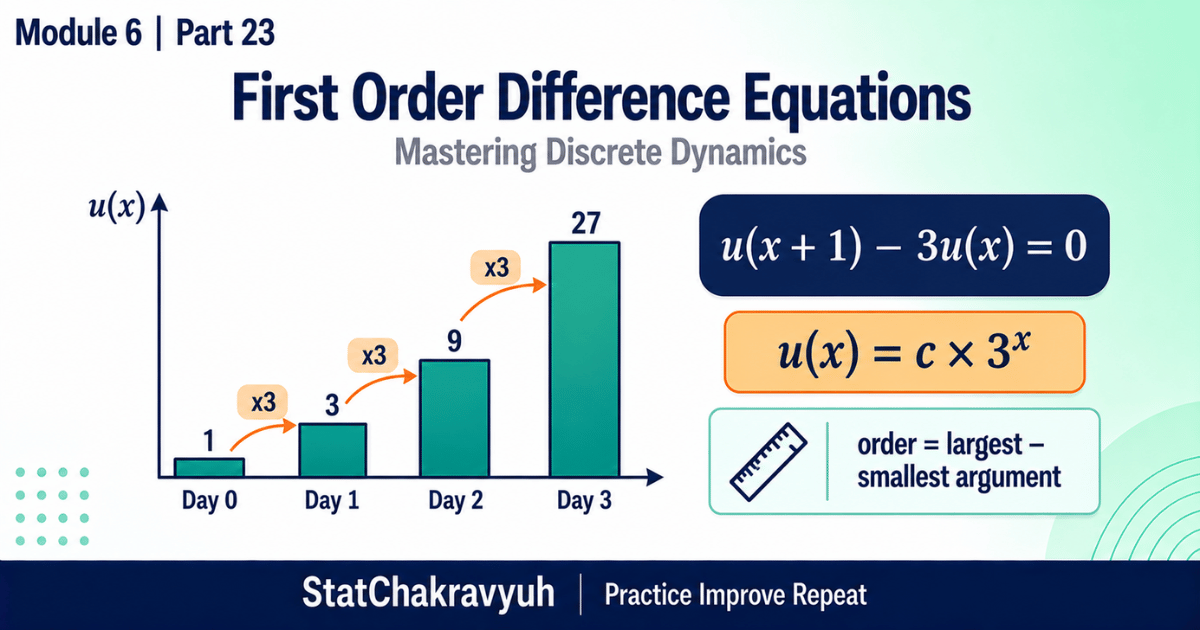
Welcome to Part 23 and the opening of Module 6, updated for the UPSC ISS 2026 to 2027 cycle. With the heavy calculus of Module 5 behind you, we shift gears into the quick win territory of the syllabus: Difference Equations. Differential equations describe continuous change through ; difference equations describe discrete change, data that jumps in distinct steps, like yearly census figures, monthly sales, or daily infection counts.
A difference equation relates an independent variable, a dependent variable, and the successive differences or values of that dependent variable: . Its order is the largest argument minus the smallest, and the general solution of is always .
The exam context: 80 questions worth 200 marks in 2 hours, 2.5 marks per correct answer, about 0.83 deducted per wrong one, close to 20 questions from Numerical Analysis. Module 6 questions are short, pattern based, and among the fastest marks on the whole paper.
This post is Part 23 of the Summation of Series and Difference Equations Guide (Module 6), inside our UPSC ISS Numerical Analysis Complete Guide. New to the exam? Start at the UPSC ISS hub.
The Story of Ananya and the Viral Outbreak
Ananya, an ISS officer in the Ministry of Health, is tracking a new viral strain. Health centres report once daily at midnight, and she spots the pattern: the case count today is exactly 3 times yesterday’s count. Mathematically, .
Her senior asks: with 5 cases on Day 0, how many on Day 10? Continuous calculus is useless here; the data jumps in daily steps. Ananya recognizes a first order homogeneous difference equation, writes the general solution instantly, fixes from Day 0, and reports for Day 10. Thirty seconds, zero tables.
What Is a Difference Equation
A difference equation involves an independent variable, a dependent variable, and the successive differences or successive values of the dependent variable. In practice it is far more convenient to work with successive values () than with differences (), and the conversion between the two notations uses the fundamental relation from Part 2:
These equations power mathematical and economic models wherever data arrives periodically.
The Ultimate Exam Trap: Finding the Order
The golden rule. The order of a difference equation is the difference between the largest and smallest arguments appearing in it. Not the largest shift, not any algebraic degree.
Three worked identifications:
- : largest argument , smallest , order .
- : largest , smallest , order . The visible is bait; the order is still 1.
- : largest , smallest , order .
Solving the First Order Equation
The standard form with a constant coefficient is with . Try : substituting gives , which holds identically. So:
What exactly is c? In continuous calculus, integration produces an arbitrary constant. In discrete equations, is technically an arbitrary periodic function of x with period 1, such as . Since the syllabus deals with integer values of , a period 1 function never changes between integers and behaves exactly like a constant. This subtlety is itself a one liner theory question.
StatChakravyuh Pro Tips
- The Δ conversion hack. Given an equation in notation, substitute before judging the order. For , the highest power becomes , giving , and the lowest term is , so the order is 3.
- The direct inverse difference trick. If the equation reads , the left side is exactly . Then , the discrete twin of an indefinite integral.
- Variable coefficients. For , the solution is the continued product , the discrete analogue of the integrating factor.
Solved PYQ Masterclass
PYQ pattern (direct solution type): What is the general solution of ?
(a) (b) (c) (d)
The 5 second logic. The equation matches the standard form with , and the master solution is always . Substituting gives .
Final Answer: (c), earned by pattern matching alone.
Common Traps to Avoid
Trap 1: Reading and declaring order 3. Only the spread between the largest and smallest arguments matters.
Trap 2: Writing or . The base is the coefficient a; the constant multiplies outside.
Trap 3: Judging the order of a form equation without first converting to .
Frequently Asked Questions
How does a difference equation differ from a differential equation?
Differential equations model continuous change using derivatives. Difference equations model discrete, step by step change using finite differences or successive values like and .
How is the order determined?
The order is the difference between the largest and smallest arguments. For example, has order .
What does the constant c really represent?
An arbitrary periodic function of with period 1. For integer arguments it never changes, so it acts exactly like an ordinary constant.
Can operator algebra solve difference equations?
Yes. Converting through turns any difference equation into a polynomial in , which factorizes algebraically just like an auxiliary equation in differential calculus.
Take the Next Step with StatChakravyuh
Join the Free UPSC ISS WhatsApp Community. Every part of this series, plus the Module 6 Practice PDF with 30 MCQs, is delivered there first. 👉 Join the WhatsApp Community now
Enroll in the Free UPSC ISS Course. Structured lessons and practice sets built on the Practice Improve Repeat system, at zero cost. 👉 Enroll in the Free Course
Coming up in Part 24: higher order equations with the Complementary Function and Particular Integral method, the discrete twin of differential calculus.