
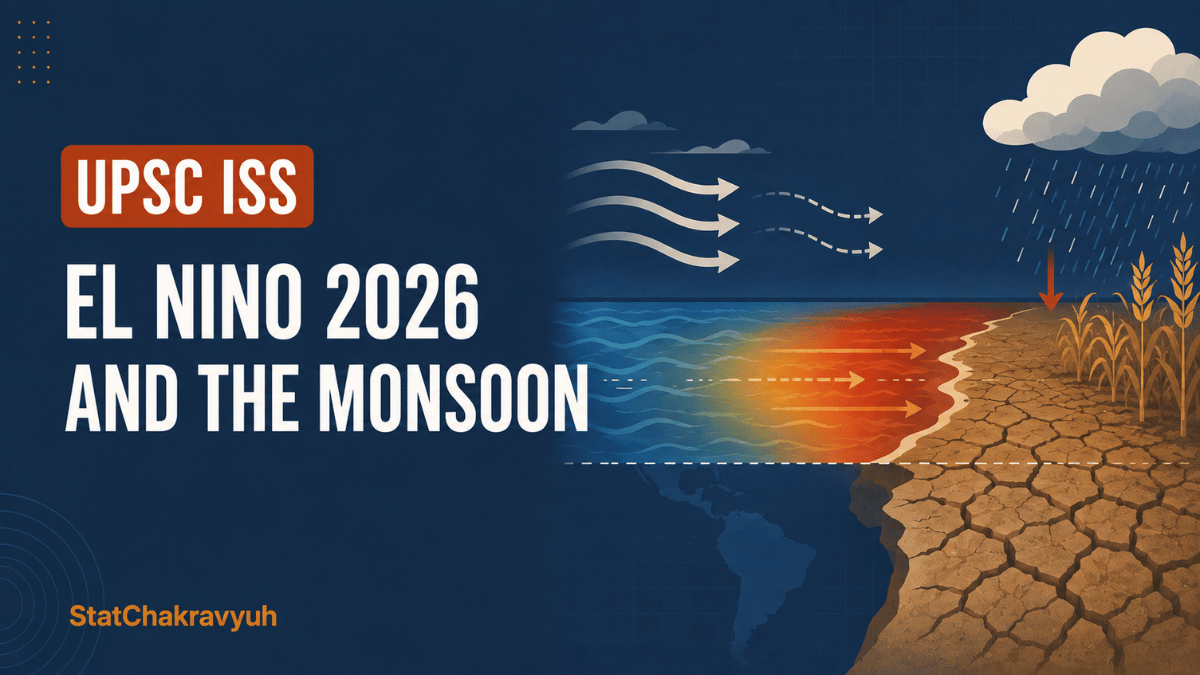
Ask any ISS aspirant to name a geography topic they are confident about and El Nino comes up almost immediately. Ask them to write 200 words on it and something odd happens. The first hundred words are perfect ocean science, the next fifty drift into general climate change, and the answer ends without a single Indian number in it. The examiner reads a good essay about the Pacific Ocean and gives it three marks out of five.
The fix is simple. In this paper, El Nino is never only a geography question. It is a geography question that has to land in the Indian economy.
Short answer. El Nino is the warm phase of the El Nino Southern Oscillation, in which sea surface temperatures in the central and eastern equatorial Pacific rise abnormally, trade winds weaken and global atmospheric circulation shifts. For India it usually means a weaker Southwest Monsoon. For 2026, the India Meteorological Department has projected monsoon rainfall at 92 percent of the Long Period Average, which is below normal, and the Reserve Bank of India has cited this risk while raising its inflation forecast.
What is El Nino and how does it work?
El Nino, Spanish for “the little boy”, is the warm phase of a coupled ocean and atmosphere cycle called the El Nino Southern Oscillation. That cycle is among the strongest drivers of year to year climate variability anywhere on earth.
Normal conditions in the Pacific
- Strong trade winds blow from east to west across the equatorial Pacific.
- These winds push warm surface water towards Australia and Southeast Asia.
- Along the western coast of South America, cold and nutrient rich water rises to the surface through upwelling.
El Nino conditions
- The trade winds weaken, and in strong events they can even reverse.
- Warm surface water shifts eastward towards the Americas.
- Upwelling of cold water is suppressed, which changes both ocean circulation and the atmospheric pressure patterns above it.
Because the atmosphere over the whole tropics is connected, a shift in Pacific convection alters circulation far away, including over the Indian subcontinent. The typical result for India is a weaker Southwest Monsoon. It is a tendency, not a guarantee, and a favourable Indian Ocean Dipole can partly offset it, which is a useful nuance to carry into an answer.
What is the monsoon outlook for 2026?
| Indicator | Position for 2026 |
|---|---|
| Probability of El Nino developing, May to July 2026 | About 82 percent, as per the National Oceanic and Atmospheric Administration |
| Probability of continuation through winter 2026-27 | About 96 percent |
| Southwest Monsoon forecast | 92 percent of the Long Period Average, India Meteorological Department |
| Category | Below normal |
| Share of annual rainfall from the monsoon | About 70 percent |
| Share of net sown area that is rainfed | Nearly half |
One clarification that earns marks: the Long Period Average is the long run mean of seasonal rainfall used as the benchmark by the India Meteorological Department. Rainfall between 96 and 104 percent of it is called normal, so 92 percent sits clearly in the below normal band.
How does El Nino affect the Indian economy?
This is the half of the answer that most students leave out, and it is the half that separates a three mark answer from a five mark one.
Agriculture
Kharif crops carry the risk first, particularly rice, cotton, soybean and pulses. Deficient rainfall delays sowing and lowers yields. Farmers respond by pumping more groundwater, which raises spending on diesel and electricity, so costs rise at exactly the moment output falls. Small and marginal farmers absorb that squeeze worst, and rural indebtedness tends to rise with it.
Inflation
Lower output creates supply shortages in cereals, pulses and vegetables. Food carries a large weight in India’s Consumer Price Index, so a farm shock transmits quickly into headline inflation. Higher food prices then cut household purchasing power and can pull down demand for other goods and services.
Labour and productivity
El Nino years are commonly hotter, and heat stress reduces output in construction, agriculture, street vending and logistics. The International Labour Organization has estimated that a rise of 1.5 degrees Celsius could cost 2.2 percent of global working hours by 2030, equivalent to roughly 80 million full time jobs. The urban heat island effect widens the gap further, because wealthier households can cool their homes while informal settlements cannot.
The macroeconomic risk
Put those together and you get slower growth with higher inflation at the same time, which economists call stagflation. This is why the Reserve Bank of India explicitly flagged El Nino and a sub normal monsoon among the risks behind its June 2026 policy decision, when it cut the growth forecast to 6.6 percent and raised the inflation forecast to 5.1 percent.
How is El Nino asked in the UPSC ISS paper?
Question 2 of the General Studies paper is Geography, with physical geography and climatology dominating. El Nino and La Nina have been asked three times since 2014, alongside monsoon systems, western disturbances and cyclones. Separately, the Economy question carries one part almost every year on the biggest current economic development.
That gives El Nino two possible doors into the same paper. A single well built preparation covers both.
Model answer skeleton, about 200 words
- Opening line. Define El Nino as the warm phase of the El Nino Southern Oscillation, with abnormal warming of the central and eastern equatorial Pacific.
- Mechanism. Normal trade winds and upwelling, then their weakening and the eastward shift of warm water.
- Indian link with data. The 2026 forecast of 92 percent of the Long Period Average, the 70 percent rainfall dependence and the rainfed share of cropped area.
- Economic transmission. Crop losses, higher input costs, food inflation through the Consumer Price Index, and heat stress on labour productivity.
- Policy response. Buffer stocks, drought contingency plans, crop diversification, irrigation expansion and monetary caution.
- Closing line. El Nino creates a twin risk of slower growth with higher inflation, which makes water and food management a macroeconomic priority, not only an agricultural one.
Facts that must appear in any El Nino answer
- El Nino is the warm phase of the El Nino Southern Oscillation; La Nina is the cold phase.
- Trade winds weaken and warm water shifts eastward towards the Americas, suppressing upwelling.
- India Meteorological Department forecast for 2026: 92 percent of the Long Period Average, below normal.
- About 70 percent of India’s annual rainfall comes from the Southwest Monsoon and nearly half the net sown area is rainfed.
- The Reserve Bank of India cited El Nino while raising its inflation projection to 5.1 percent for 2026-27.
Value additions that lift the answer
- The Indian Ocean Dipole. A positive dipole can partly counteract El Nino’s drying effect on the Indian monsoon. Mentioning it shows you understand that the relationship is statistical, not mechanical.
- The historical parallel. The Great Famine of 1876 to 1878 followed successive monsoon failures associated with a strong El Nino event, a comparison meteorologists and historians have both drawn this year.
- The reverse case. La Nina years are usually associated with a stronger monsoon, so naming both phases makes the concept complete.
- Policy specificity. Instead of writing “the government should help farmers”, name the instruments: buffer stock releases, contingency crop plans, micro irrigation expansion and crop insurance.
Two mistakes to avoid
- Confusing El Nino with climate change. El Nino is a natural, cyclical oscillation that has existed for millennia. Climate change is a long term warming trend. They interact, but they are not the same thing, and mixing them is a visible conceptual error.
- Writing an ocean answer with no India in it. If your answer could have been written by a student in any country, it will not score in this paper. Half of every El Nino answer belongs to Indian agriculture, prices and growth. If your answers keep drifting like this, our breakdown of the seven common ISS answer writing mistakes is worth twenty minutes of your time.
Turn reading into written answers
Understanding El Nino takes twenty minutes. Writing a 200 word answer on it under time pressure takes practice, and practice needs feedback.
Join the UPSC ISS community on WhatsApp for monthly topic lists and doubt support.
Start the free UPSC ISS course and test yourself before the next mock.
Frequently asked questions
-
What is El Nino in simple terms?
El Nino is the warm phase of the El Nino Southern Oscillation. Sea surface temperatures in the central and eastern equatorial Pacific rise above normal, the east to west trade winds weaken, and warm water shifts towards the Americas. This changes global atmospheric circulation and often weakens the Indian Southwest Monsoon.
-
Will the monsoon be weak in 2026?
The India Meteorological Department has projected Southwest Monsoon rainfall at 92 percent of the Long Period Average, which falls in the below normal category. The National Oceanic and Atmospheric Administration has indicated a high probability of El Nino developing during May to July 2026 and continuing through the following winter. Forecasts are revised through the season, so always check the latest bulletin.
-
What is the difference between El Nino and La Nina?
They are the two opposite phases of the same oscillation. El Nino is the warm phase, with weakened trade winds and eastward movement of warm water, usually associated with a weaker Indian monsoon. La Nina is the cold phase, with stronger trade winds and cooler eastern Pacific waters, usually associated with a stronger monsoon.
-
How does El Nino cause inflation in India?
A weak monsoon lowers kharif output, which creates shortages in cereals, pulses and vegetables. Food carries a heavy weight in the Consumer Price Index, so those shortages push up headline inflation. Higher irrigation costs during a dry season add further pressure on prices and on farm incomes.
-
What is the Long Period Average in monsoon forecasts?
The Long Period Average is the long run mean of seasonal rainfall used by the India Meteorological Department as a benchmark. Seasonal rainfall between 96 and 104 percent of it is classified as normal, so a forecast of 92 percent is below normal.
-
Is El Nino important for the UPSC ISS examination?
Yes, on two counts. Question 2 of the General Studies paper is Geography, where El Nino and La Nina have been asked three times since 2014. The Economy question also carries a current development part each year, and in a below normal monsoon year this is a live candidate. For the economic side, our guide on Indian Economy for the ISS examination gives you the base concepts.
What comes next in this series
You now have History and Geography covered. The next block is Economy, and for a statistics service candidate the most examinable item of the whole month sits there: India has changed how it measures wholesale prices.
Next: The new WPI base year and India’s Producer Price Index, explained
Practice. Improve. Repeat.
Sources
India Meteorological Department (mausam.imd.gov.in), National Oceanic and Atmospheric Administration Climate Prediction Center (cpc.ncep.noaa.gov), Reserve Bank of India (rbi.org.in), International Labour Organization (ilo.org).
[…] and food prices. This is the direct link back to the previous article in this series on El Nino and the monsoon, and it is a good example of how one current affairs topic feeds […]