
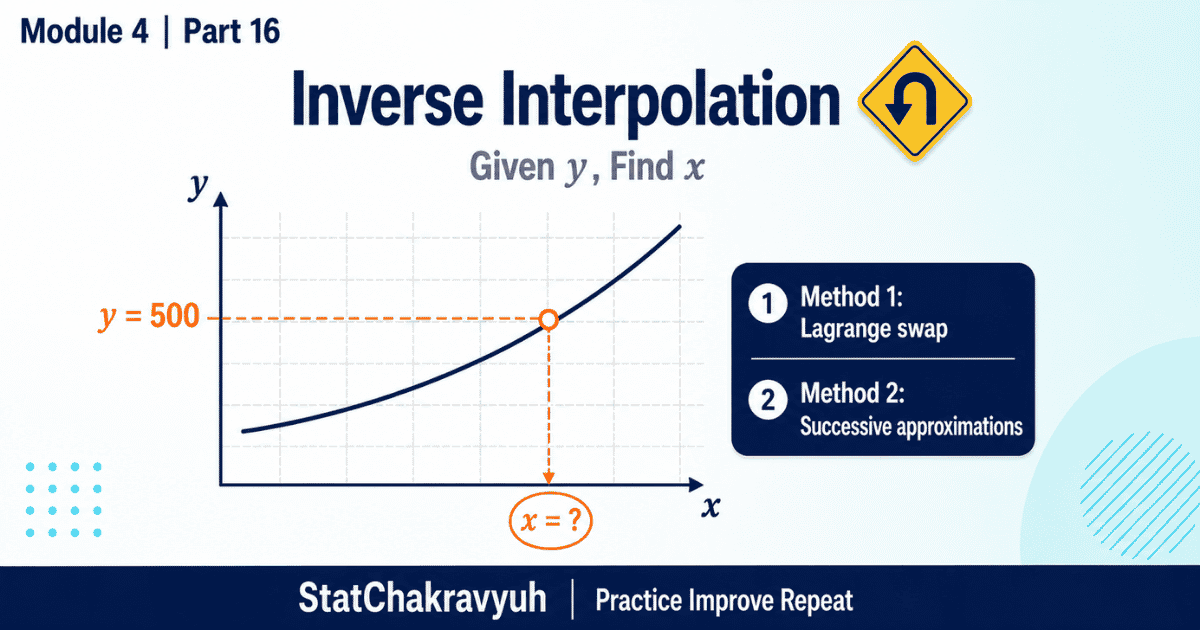
Welcome to Part 16, the final part of Module 4, updated for the UPSC ISS 2026 to 2027 cycle. So far the problem was always the same: given the arguments and their entries , predict a missing . That is direct interpolation. Today the examiner flips the script: given a value of , find the corresponding . This reverse engineering is Inverse Interpolation.
Two methods dominate: Lagrange’s inversion, where and are interchanged in Lagrange’s formula because either variable can serve as the independent one, and the iterative method of successive approximations built on Newton’s forward formula. As a bonus, inverse interpolation with hunts down real roots of equations.
The exam context stays fixed: 80 questions, 200 marks, 2 hours, 2.5 marks per question, about 0.83 deducted per wrong answer, roughly 90 seconds per question. The solved example below fits comfortably inside 30 of those seconds.
This post is Part 16 of the Unequal Intervals and Inverse Interpolation Guide (Module 4), inside our UPSC ISS Numerical Analysis Complete Guide. Full roadmap at the UPSC ISS hub.
The Story of Rahul and the Tax Milestone
Rahul, a new ISS officer in the Ministry of Finance, has income tax collection figures in thousand crores: 200 in 2018, 350 in 2020, and 600 in 2022. His director asks a flipped question: in which exact year did the collection cross 500?
The target here is , and the unknown is the argument . This is not standard interpolation. Rahul swaps the axes in Lagrange’s formula, treats as the independent variable, and computes the exact crossing point in 2 minutes, no calculator involved.
Method 1: Lagrange’s Inversion, the Easy Swap
The most popular route. From Part 15 we know Lagrange’s formula is merely a relation between two variables, and either one can be taken as independent. To find for a given , treat as the argument and as the entry, swapping their places everywhere:
When to prefer it: when the values are unequally spaced, which they almost always are, or when the data has only 3 or 4 points.
Method 2: The Iterative Method of Successive Approximations
For long tables with equally spaced values, start from Newton’s forward formula, and transpose it to isolate the step value , since :
How the iteration runs. First approximation: neglect higher differences and take . Second approximation: substitute into the right side to obtain . Third: substitute to obtain . Continue until two successive values of agree, then recover .
StatChakravyuh Pro Tips
- The convergence check. The iteration behaves well only when the higher differences shrink rapidly. If they grow, abandon the iteration and switch to Lagrange’s inversion.
- The root finding hack. To find a real root of , tabulate a few values of and near the suspected root, then apply inverse interpolation with . The root falls out directly.
- The swap monopoly. Only Lagrange permits the free interchange of and . Newton’s Divided Difference and Newton Gregory formulas never allow a column swap, because the values will not be equally spaced. Statements based questions test exactly this contrast.
Solved PYQ Masterclass
PYQ pattern (root finding by inversion, a recurring type): The function takes the value at and at . Assuming the function is linear, find the root of .
Mental solution.
- The goal: find when . Pure inverse interpolation.
- Data: and .
- Apply the inverted two point Lagrange formula:
- Substitute :
Final Answer: , verified by hand, with no linear equations and no difference tables. A quick sanity check: the function changes sign between 1 and 2, so a root between them is exactly what we expect, and 1.25 sits closer to the endpoint where the function is nearer to zero.
Common Traps to Avoid
Trap 1: Reversing the and columns and feeding them into Newton’s forward formula. The values are almost never equally spaced, so the formula breaks silently.
Trap 2: Iterating when the differences are growing. The iteration then diverges or crawls; recognize it early and swap methods.
Trap 3: Forgetting the final conversion after finding in the iterative method. Options with the bare value are planted for exactly this slip.
Frequently Asked Questions
-
What is inverse interpolation?
Direct interpolation finds for a given . Inverse interpolation finds the argument corresponding to a given intermediate value of the function .
-
Can I reverse the columns and use Newton’s forward formula?
No. Newton’s formula needs the independent variable at strictly equal intervals, and the values will almost certainly be unequally spaced.
-
Why is Lagrange’s formula the natural tool here?
Because it is merely a relation between two variables with no spacing requirement, so can safely be treated as the independent variable by interchanging the two everywhere.
-
When is the iterative method preferable?
With a long table of equally spaced values whose forward differences decrease rapidly. It then avoids the heavy fractional multiplications of Lagrange’s inversion.
-
How does inverse interpolation find roots of equations?
A root of is the value of where . Tabulate a few points near the suspected root and apply inverse interpolation with to extract it directly.
Take the Next Step with StatChakravyuh
Join the Free UPSC ISS WhatsApp Community. The Module 4 Practice PDF with 40 MCQs, a formula sheet, and the PYQ pattern collection releases in the community. 👉 Join the WhatsApp Community now
Enroll in the Free UPSC ISS Course. Structured lessons and practice sets on the Practice Improve Repeat system, at zero cost. 👉 Enroll in the Free Course
Module 4 is complete, and with it your entire interpolation toolkit. Next stop, Module 5: the most heavily tested section of the syllabus, Numerical Differentiation and Integration, calculus without calculators.