
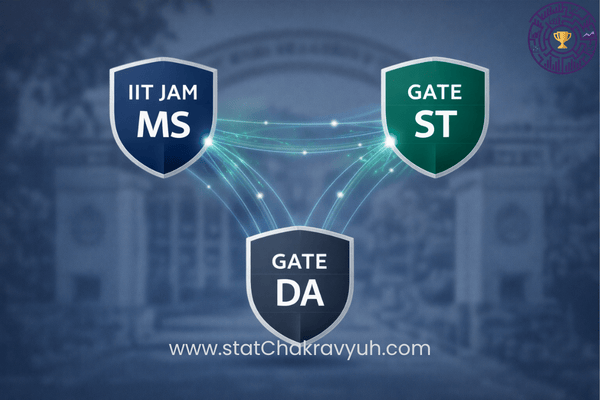
If you are a B.Sc. Statistics student planning your next step, you have probably come across three major exams: IIT JAM Mathematical Statistics (MS), GATE Statistics (ST), and GATE Data Science and Artificial Intelligence (DA). All three exams involve statistics and probability – but they lead to very different outcomes.
Choosing the right exam (or combination of exams) can significantly impact your career trajectory. In this article, we will compare these three exams across every important dimension – syllabus, difficulty, career scope, eligibility, and preparation strategy – so you can make an informed decision.
Quick Overview – What Is Each Exam For?
IIT JAM MS (Mathematical Statistics) is conducted for admission to M.Sc. programs at IITs, IISc, and NITs. It is a pure science entrance exam, and the primary goal is academic admission for a two-year master’s degree. The JAM 2026 exam was conducted on February 15, 2026, by IIT Bombay.
GATE ST (Statistics) is part of the Graduate Aptitude Test in Engineering. It is used for M.Tech admissions at IITs and NITs, direct PhD admissions, research fellowships, and PSU recruitment. GATE 2026 was conducted by IIT Guwahati on February 7, 8, 14, and 15, 2026.
GATE DA (Data Science and AI) is a relatively new GATE paper introduced in 2024. It covers probability, statistics, linear algebra, machine learning, and artificial intelligence. It is designed for candidates interested in pursuing M.Tech in Data Science, AI, or related fields.
Syllabus Comparison
This is where things get interesting. There is significant overlap between these three exams — particularly between JAM MS and GATE ST – but each has unique topics as well.
Common Topics Across All Three Exams: Probability and probability distributions, linear algebra (matrices, eigenvalues, vector spaces), calculus (single and multivariable), random variables and expectation, and standard distributions (Normal, Binomial, Poisson, Exponential, Uniform) are tested in all three papers.
JAM MS Specific Topics: The JAM MS paper is divided into Mathematics (40% weightage) and Statistics (60% weightage). The mathematics portion includes real analysis, sequences and series, differential equations, and integral calculus at a deeper level than GATE. Unique JAM MS topics include descriptive statistics, Beta and Gamma integrals and functions, and Cramer’s Rule for solving linear systems.
GATE ST Specific Topics: GATE Statistics includes everything in JAM MS’s statistics section plus additional advanced topics like multivariate analysis (multivariate normal distribution, Wishart distribution, Hotelling’s T-squared test), regression analysis (multiple regression, ANOVA, model diagnostics), non-parametric statistics, and stochastic processes at a more advanced level. GATE ST also includes 15 marks of General Aptitude (verbal and quantitative reasoning), which is not part of JAM.
GATE DA Specific Topics: GATE DA covers probability and statistics at a moderate level but adds significant content from computer science and engineering – including machine learning (supervised, unsupervised, reinforcement learning), data structures and algorithms, artificial intelligence (search, optimization), and database systems. The statistical depth in DA is less than in ST, but the breadth across data science topics is much wider.
Exam Pattern Comparison
| Feature | JAM MS | GATE ST | GATE DA |
|---|---|---|---|
| Total Marks | 100 | 100 | 100 |
| Total Questions | 60 | 65 | 65 |
| Duration | 3 hours | 3 hours | 3 hours |
| Question Types | MCQ, MSQ, NAT | MCQ, MSQ, NAT | MCQ, MSQ, NAT |
| Negative Marking | MCQ only (-1/3 for 1 mark, -2/3 for 2 marks) | MCQ only (-1/3 for 1 mark, -2/3 for 2 marks) | MCQ only (-1/3 for 1 mark, -2/3 for 2 marks) |
| General Aptitude | No | Yes (15 marks) | Yes (15 marks) |
| Subject Weightage | Math 40%, Stats 60% | Core Stats 85%, GA 15% | Core DA 85%, GA 15% |
| Conducting Body | IITs (rotation) | IITs (rotation) | IITs (rotation) |
Difficulty Level – How Do They Compare?
JAM MS is considered moderate in difficulty. The mathematics section tests conceptual understanding of real analysis and calculus, which many B.Sc. Statistics students find challenging since their curriculum may not have covered these topics in depth. The statistics section is more straightforward for well-prepared candidates.
GATE ST is generally considered tougher than JAM MS, primarily because of the additional advanced topics (multivariate analysis, non-parametric methods, advanced regression). The questions are more application-oriented and analytical. However, the General Aptitude section is relatively easy and provides a chance to score 15 easy marks.
GATE DA has a different kind of difficulty. For statistics students, the probability and statistics section is manageable, but the machine learning, AI, and data structures sections can be challenging if you don’t have a computer science background. The 2026 GATE DA paper was rated moderate to slightly tough by students, with mathematics-focused questions requiring careful calculation.
Career Scope Comparison
| Career Path | JAM MS | GATE ST | GATE DA |
|---|---|---|---|
| M.Sc. at IITs/IISc | Yes (primary purpose) | No | No |
| M.Tech at IITs/NITs | No | Yes | Yes |
| Direct PhD | Indirectly (after M.Sc.) | Yes | Yes |
| Research Fellowships (JRF) | No | Yes | Yes |
| PSU Jobs | No | Limited | Limited |
| Data Science Industry | After M.Sc. | After M.Tech/directly | After M.Tech/directly |
| GATE Score Validity | N/A | 3 years | 3 years |
| Academic Career | After completing M.Sc. | After M.Tech/PhD | After M.Tech/PhD |
| Government (UPSC ISS) | Complementary | Complementary | Less relevant |
Which Exam Should You Choose?
The answer depends on your background and career goals.
Choose JAM MS if: You are in the final year of B.Sc. Statistics or B.Stat, and your primary goal is to get into an IIT or IISc for a two-year M.Sc. program. JAM is the most direct route to an M.Sc. degree from a top institute. If you love pure statistics and want to build a strong academic foundation before entering the job market or research, JAM is the right choice.
Choose GATE ST if: You want to keep multiple options open – M.Tech admission, PhD admission, research fellowship, and potential government or industry roles. GATE ST is also the right choice if you are already an M.Sc. student and want to pursue an M.Tech or PhD. The GATE score’s three-year validity gives you flexibility.
Choose GATE DA if: You are more interested in the applied side – machine learning, AI, and data science — and you have some background in programming and algorithms. GATE DA is less suited for pure statistics students who don’t have computer science exposure, but it’s excellent for those at the intersection of statistics and technology.
The Smart Strategy – Prepare for Multiple Exams: Here is something many toppers do: since JAM MS and GATE ST share approximately 85% of their statistics syllabus, preparing for both exams simultaneously is highly efficient. You build your core statistics knowledge once and apply it across both papers. The additional effort needed is mainly for GATE’s General Aptitude section and a few extra topics like multivariate analysis and non-parametric statistics.
This is exactly the approach that StatChakravyuh’s test series is designed around. The JAM + GATE Statistics combined batch recognizes the significant syllabus overlap and provides integrated practice that covers both exams efficiently. From diagnostic entry tests to full-length mock exams, the phased structure helps you build strength progressively – no matter which exam you are targeting.
Preparation Timeline
If you are starting fresh, here is a rough timeline that works for both JAM MS and GATE ST:
Months 1–3: Build foundations in probability, linear algebra, and calculus. Cover all standard distributions thoroughly.
Months 4–6: Move to inference, estimation, hypothesis testing, and regression. Start GATE-specific topics like multivariate analysis.
Months 7–9: Begin full-length mock tests. Identify weak areas and revise selectively.
Months 10–12: Intensive revision, PYQ solving, and exam simulation. Focus on time management and accuracy.
Final Verdict
There is no single “best” exam – the best exam is the one that aligns with your goals. But for most B.Sc. Statistics students, the combination of JAM MS + GATE ST offers the widest range of opportunities with the least additional preparation effort. GATE DA can be added to the mix if you have a computer science background or are willing to invest extra time in learning programming and ML fundamentals.
Whatever you choose, the key is to start early, practice consistently, and use the right resources.
StatChakravyuh offers a combined JAM + GATE Statistics test series designed for aspirants who want to maximize their preparation efficiency. Practice. Improve. Repeat.