
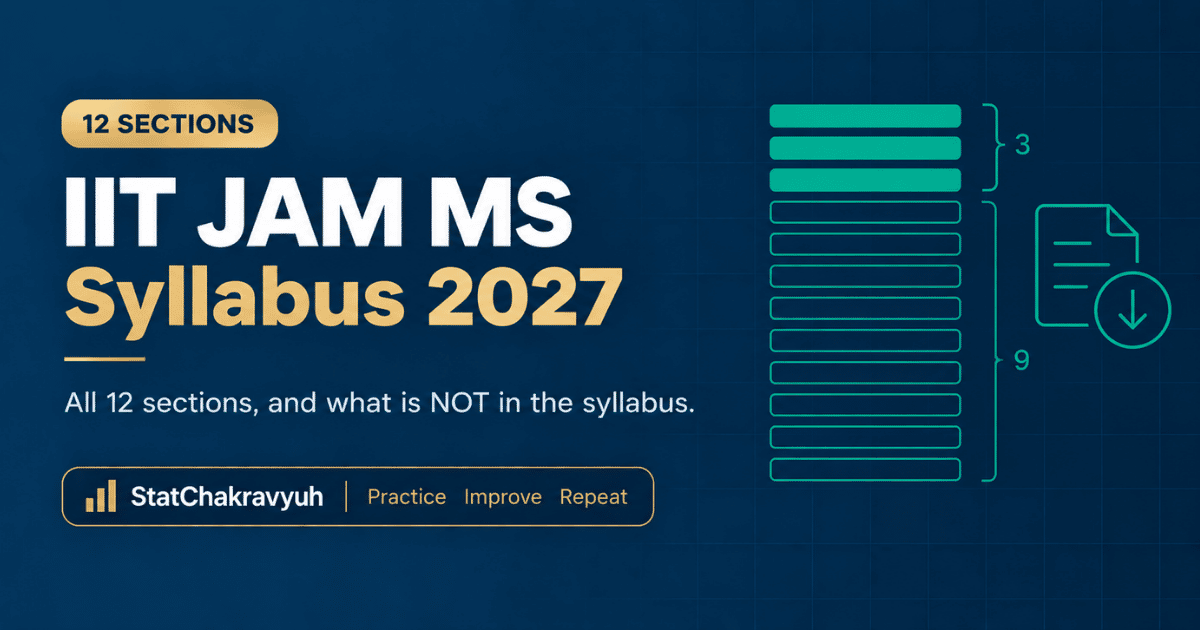
Quick answer. The IIT JAM Mathematical Statistics 2027 syllabus has 12 sections. Sections 1 to 3 are Mathematics, carrying about 25 percent weight, and sections 4 to 12 are Statistics, carrying about 75 percent. The Mathematics sections are Sequences and Series of Real Numbers, Differential and Integral Calculus, and Matrices and Determinants. The Statistics sections are Descriptive Statistics and Probability, Univariate Distributions, Multivariate Distributions, Limit Theorems, Sampling Distributions, Estimation, Testing of Hypotheses, Nonparametric Methods, and Stochastic Processes.
Download the Official JAM 2027 Information Brochure
The complete MS syllabus is in Annexure I. Straight from the IIT Kharagpur JAM 2027 website.
The 12 Section Structure
| No. | Section | Part |
|---|---|---|
| 1 | Sequences and Series of Real Numbers | Mathematics, about 25 percent |
| 2 | Differential and Integral Calculus | Mathematics |
| 3 | Matrices and Determinants | Mathematics |
| 4 | Descriptive Statistics and Probability | Statistics, about 75 percent |
| 5 | Univariate Distributions | Statistics |
| 6 | Multivariate Distributions | Statistics |
| 7 | Limit Theorems | Statistics |
| 8 | Sampling Distributions | Statistics |
| 9 | Estimation | Statistics |
| 10 | Testing of Hypotheses | Statistics |
| 11 | Nonparametric Methods | Statistics |
| 12 | Stochastic Processes | Statistics |
Part One: Mathematics, Sections 1 to 3
Section 1: Sequences and Series of Real Numbers
Sequences. Sequences of real numbers, their convergence and limits. Cauchy sequences and their convergence. Monotonic sequences and their limits. Limits of standard sequences. Limit superior and limit inferior of sequences.
Series. Infinite series, its convergence and divergence. Convergence of series with non negative terms.
Tests for convergence and divergence. Comparison test, limit comparison test, D’Alembert’s ratio test, Cauchy’s nth root test, Cauchy’s condensation test, and integral test.
Further convergence topics. Absolute convergence of series. Leibnitz’s test for the convergence of alternating series. Conditional convergence. Convergence of power series and radius of convergence.
Section 2: Differential and Integral Calculus
Differential Calculus of One Variable
Limits of functions of one real variable. Continuity and differentiability of functions of one real variable. Properties of continuous and differentiable functions of one real variable. Rolle’s theorem and Lagrange’s mean value theorem. Higher order derivatives, Leibnitz’s rule and its applications. Taylor’s theorem with Lagrange’s and Cauchy’s forms of remainder. Taylor’s and Maclaurin’s series of standard functions. Indeterminate forms and L’Hospital’s rule. Maxima and minima of functions of one real variable, critical points, local maxima and minima, global maxima and minima, and point of inflection.
Differential Calculus of Two Variables
Limits of functions of two real variables. Continuity and differentiability of functions of two real variables. Properties of continuous and differentiable functions of two real variables. Partial differentiation and total differentiation. Leibnitz’s rule for successive differentiation. Maxima and minima of functions of two real variables, critical points, Hessian matrix, and saddle points. Constrained optimization techniques with Lagrange multipliers.
Integral Calculus
Fundamental theorems of integral calculus for single integrals. Leibnitz’s rule and its applications. Differentiation under the integral sign. Improper integrals. Beta and Gamma integrals, their properties and the relationship between them. Double integrals. Change of order of integration. Transformation of variables. Applications of definite integrals including arc lengths, areas and volumes.
Section 3: Matrices and Determinants
Vector spaces. R to the power n and C to the power n as vector spaces over the real field. Span of a set. Linear dependence and independence. Dimension and basis. Null space.
Matrix algebra and standard matrices. Algebra of matrices. Symmetric and skew symmetric matrices. Hermitian and skew Hermitian matrices. Orthogonal and unitary matrices. Idempotent and nilpotent matrices.
Determinants. Definition, properties and applications of determinants. Evaluation of determinants using transformations. Determinant of a product of matrices. Singular and non singular matrices and their properties.
Matrix operations. Trace of a matrix. Adjoint and inverse of a matrix and related properties. Rank and nullity of a matrix, row rank, column rank, standard theorems on ranks, rank of the sum and the product of two matrices. Row reduction and echelon forms.
Systems of linear equations. Consistent and inconsistent systems. Properties of solutions. Use of determinants in solving systems of linear equations. Cramer’s rule.
Eigen theory and quadratic forms. Characteristic roots and characteristic vectors and their properties. Cayley Hamilton theorem. Quadratic forms, positive definite, positive semi definite, negative definite and negative semi definite matrices and their simple properties.
Part Two: Statistics, Sections 4 to 12
Section 4: Descriptive Statistics and Probability
Descriptive Statistics
Concepts of sample and population. Different types of data. Tabular and graphical representation of data. Measures of central tendency: arithmetic mean, geometric mean, harmonic mean, median and mode. Measures of dispersion: range, interquartile range, mean deviation about a point, standard deviation, variance and coefficient of variation. Moments, central moments, skewness and kurtosis.
Bivariate Data
Scatter diagram, covariance, simple correlation, partial correlation and multiple correlation for three variables only, and Spearman’s rank correlation.
Probability
Random experiments. Sample space and algebra of events. Relative frequency and axiomatic definitions of probability. Properties of the probability function. Addition theorem of probability, the inclusion exclusion principle. Geometric probability. Boole’s and Bonferroni’s inequalities. Conditional probability and the multiplication rule. Theorem of total probability and Bayes’ theorem. Pairwise and mutual independence of events.
Section 5: Univariate Distributions
Definition of random variables. Cumulative distribution function of a random variable. Discrete and continuous random variables. Probability mass function and probability density function. Distribution of a function of a random variable using transformation of variables and the Jacobian method.
Mathematical expectation and moments. Mean, median, mode, variance, standard deviation, coefficient of variation, quantiles, quartiles, and measures of skewness and kurtosis of a probability distribution. Moment generating function, its properties and uniqueness. Markov and Chebyshev inequalities and their applications.
Standard distributions. Degenerate, Bernoulli, Binomial, Negative binomial, Geometric, Poisson, Hypergeometric, Uniform, Exponential, Double exponential, Gamma, Beta of the first and second type, Normal and Cauchy distributions, along with their properties, interrelations and limiting or approximation cases.
Section 6: Multivariate Distributions
Definition of random vectors. Joint and marginal cumulative distribution functions of a random vector. Discrete and continuous type random vectors. Joint and marginal probability mass functions, joint and marginal probability density functions. Conditional cumulative distribution function, conditional probability mass function and conditional probability density function. Independence of random variables.
Distribution of functions of random vectors using transformation of variables and the Jacobian method. Mathematical expectation of functions of random vectors. Joint moments, covariance and correlation. Joint moment generating function and its properties. Uniqueness of the joint moment generating function and its applications. Conditional moments, conditional expectations and conditional variance.
Additive properties of Binomial, Poisson, Negative Binomial, Gamma and Normal distributions using their moment generating functions. Multinomial distribution as a generalisation of the binomial distribution and its properties including moments, correlation, marginal distributions and the additive property. Bivariate normal distribution, its marginal and conditional distributions and related properties.
Section 7: Limit Theorems
Convergence in probability, convergence in mean square, almost sure convergence, convergence in distribution, and their interrelations.
Weak law of large numbers. Strong law of large numbers. Central Limit Theorem for the independent and identically distributed, finite variance case.
This section is short on the page and rewards careful revision. Questions typically test which mode of convergence implies which.
Section 8: Sampling Distributions
Foundations. Definitions of random sample, parameter and statistic. Sampling distribution of a statistic.
Order statistics. Definition and distribution of the rth order statistic, distribution function and probability density function for the independent and identically distributed continuous case. Distribution of the smallest and largest order statistics for the independent and identically distributed case, for both discrete and continuous distributions.
Central chi square distribution. Definition and derivation of the probability density function of the central chi square distribution with n degrees of freedom using the moment generating function. Properties, additive property and limiting form.
Central t distribution. Definition and derivation of the probability density function with n degrees of freedom. Properties and limiting form.
Central F distribution. Definition and derivation of the probability density function with m and n degrees of freedom. Properties and the distribution of the reciprocal of an F variate.
Relationships. The relationship between the t, F and chi square distributions.
Section 9: Estimation
Unbiasedness. Sufficiency of a statistic. Factorization theorem. Complete statistic. Consistency and relative efficiency of estimators. Uniformly Minimum Variance Unbiased Estimator. Rao Blackwell and Lehmann Scheffe theorems and their applications. Cramer Rao inequality and UMVUEs.
Methods of estimation. Method of moments, method of maximum likelihood, and invariance of maximum likelihood estimators. Least squares estimation and its applications in simple linear regression models.
Interval estimation. Confidence intervals and confidence coefficient. Confidence intervals for the parameters of the univariate normal distribution, two independent normal distributions, and the exponential distribution.
This is where regression sits in JAM MS. Least squares estimation applied to simple linear regression models is part of Section 9. There is no separate Regression Analysis section, and multiple linear regression, R squared, the Gauss Markov theorem and the Fisher Cochran theorem are not listed in the JAM MS syllabus. Those belong to GATE ST.
Section 10: Testing of Hypotheses
Null and alternative hypotheses, both simple and composite. Type I and Type II errors. Critical region. Level of significance, size and power of a test, and the p value.
Most powerful critical regions and most powerful tests. Uniformly most powerful tests. Neyman Pearson Lemma, stated without proof, and its applications to the construction of MP and UMP tests for the parameter of one parameter parametric families.
Likelihood ratio tests for the parameters of the univariate normal distribution.
Section 11: Nonparametric Methods
Tests of randomness based on the total number of runs. Empirical distribution function. Kolmogorov Smirnov one sample test. One and two sample sign tests. Mann Whitney test.
That is the complete section. It is considerably narrower than most book lists suggest, which is worth knowing before you buy a full nonparametric textbook.
Section 12: Stochastic Processes
Discrete time Markov chains. Transition probability matrix. Higher order transition probabilities. Markov chain as a graph. Chapman Kolmogorov equation. Classification of states and chains. Stability of a Markov chain, meaning stationary and limiting distributions.
Poisson process. The Poisson process and its properties. Interarrival and waiting times.
This section is the one most students are least prepared for, because older JAM MS material does not cover it and most Statistics undergraduate courses treat it as an optional elective. Give it dedicated time rather than leaving it to the end.
What Is NOT in the JAM MS 2027 Syllabus
This section saves more time than any other on this page. Every item below appears in standard textbooks or in the GATE ST syllabus, and none of them are in JAM MS 2027.
- Regression Analysis as a standalone section
- Multiple linear regression, R squared and adjusted R squared
- Gauss Markov theorem and Fisher Cochran theorem
- Wilcoxon signed rank test
- Kruskal Wallis test
- Kendall rank correlation
- Two sample Kolmogorov Smirnov test
- Minimal sufficiency
- Monotone likelihood ratio property
- Uniformly Most Powerful Unbiased tests
- Multivariate normal distribution beyond the bivariate case
- Hotelling’s T squared test and the Wishart distribution
- Singular value decomposition
- Design of experiments and analysis of variance
- Survey sampling techniques
- Time series and index numbers
- Brownian motion and birth and death processes
An important clarification for students preparing for both examinations. Many of the items above are squarely in the GATE ST syllabus. Studying them is not wasted effort if GATE is also your target. It is wasted effort if JAM MS is your only target. Keep two separate checklists and know which hours are going where.
Note also that Spearman’s rank correlation is in the syllabus, but it sits in Section 4 under bivariate descriptive statistics, not in Section 11.
How to Use This Syllabus as a Checklist
- Paste the syllabus into a spreadsheet, one row per topic. You will end up with roughly 120 rows.
- Add four columns: Theory Done, Questions Solved, PYQ Done, Revised.
- Never tick Theory Done alone. A topic is not finished until Questions Solved is ticked too.
- Tick PYQ Done immediately after each topic, not at the end of the syllabus.
- Review the sheet every Sunday. Rows with only the first column ticked are your weak points.
That one sheet answers the question every aspirant asks in December: what exactly is left.
A Syllabus Is a Checklist, Not a Study Plan
Practice built around the real JAM pattern: three sections, sixty questions, three hours, on an interface that matches the exam with a virtual calculator and a disabled keyboard for numerical entry.
Frequently Asked Questions
How many sections are in the IIT JAM MS 2027 syllabus?
Twelve. Sections 1 to 3 are Mathematics, carrying about 25 percent weight, and sections 4 to 12 are Statistics, carrying about 75 percent.
Is Regression Analysis in the JAM MS 2027 syllabus?
Not as a standalone section. Least squares estimation and its applications in simple linear regression models appear inside Section 9 on Estimation. Section 12 of the official JAM MS 2027 syllabus is Stochastic Processes.
What is Section 12 of the JAM MS syllabus?
Stochastic Processes. It covers discrete time Markov chains, transition probability matrices, higher order transition probabilities, the Chapman Kolmogorov equation, classification of states and chains, stationary and limiting distributions, and the Poisson process with interarrival and waiting times.
Is the Wilcoxon signed rank test in JAM MS?
No. Section 11 on Nonparametric Methods is limited to tests of randomness based on runs, the empirical distribution function, the Kolmogorov Smirnov one sample test, one and two sample sign tests, and the Mann Whitney test.
What is the Mathematics weightage in JAM MS?
The official syllabus describes Mathematics, sections 1 to 3, as carrying about 25 percent weight. This is a syllabus level indication and not a guarantee of the exact number of questions in any given year.
Is the multivariate normal distribution in JAM MS?
The bivariate normal distribution is in Section 6, including its marginal and conditional distributions. The general multivariate normal distribution, Hotelling’s T squared and the Wishart distribution are not in the JAM MS syllabus.
Where can I download the official JAM MS syllabus?
The complete MS syllabus is in Annexure I of the official JAM 2027 Information Brochure, available on the IIT Kharagpur JAM 2027 website.
Is descriptive statistics really in JAM MS?
Yes. Section 4 includes measures of central tendency and dispersion, moments, skewness and kurtosis. This is a genuine difference from GATE ST, where descriptive statistics is not part of the syllabus.