
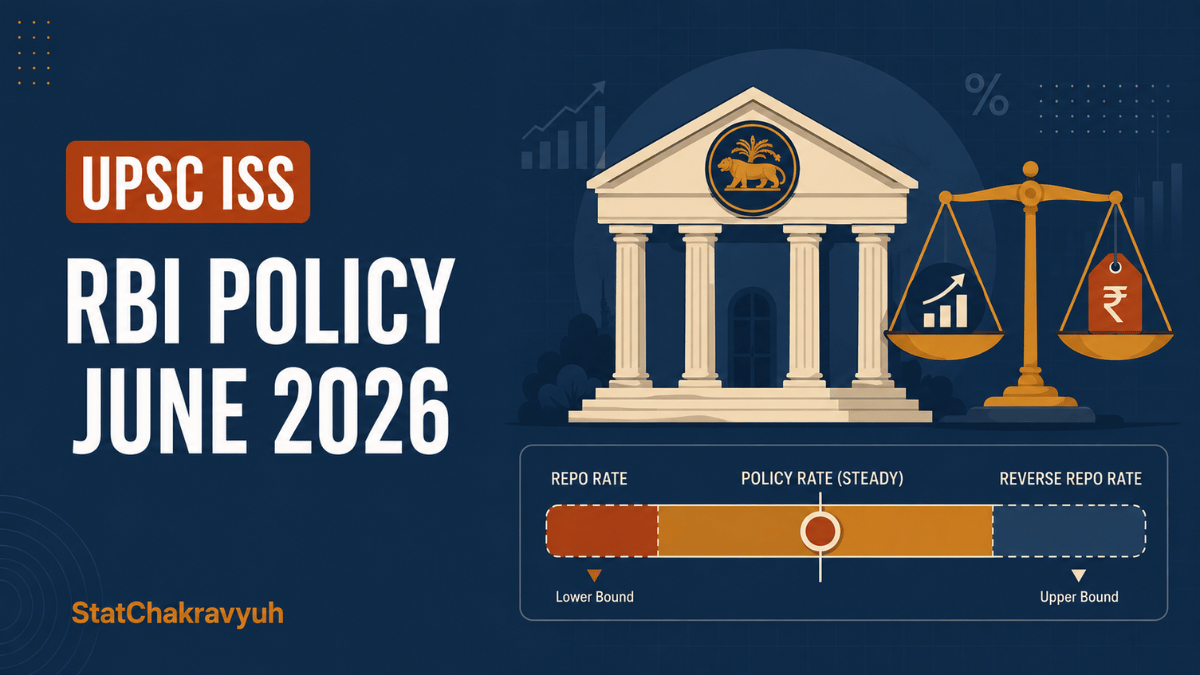
Monetary policy questions look intimidating until you notice something. The Reserve Bank does only three things in every review: it sets a rate, it declares a stance, and it publishes forecasts. Once you learn to read those three things, every policy review in your life takes ten minutes to understand. The June 2026 review is an unusually good one to learn on, because the rate did not move while everything around it did.
Short answer. In its June 2026 meeting the Monetary Policy Committee of the Reserve Bank of India unanimously kept the policy repo rate unchanged at 5.25 percent and retained a neutral stance. It cut the real growth forecast for 2026-27 from 6.9 percent to 6.6 percent and raised the Consumer Price Index inflation forecast by 50 basis points to 5.1 percent, citing crude oil near 110 United States dollars a barrel, a below normal monsoon and emerging El Nino conditions.
What the Committee actually decided
| Item | June 2026 position |
|---|---|
| Policy repo rate | 5.25 percent, unchanged, decision unanimous |
| Standing Deposit Facility rate | 5.00 percent, the floor of the corridor |
| Marginal Standing Facility rate | 5.50 percent, the ceiling of the corridor |
| Bank Rate | 5.50 percent |
| Policy stance | Neutral |
| Real growth forecast, 2026-27 | 6.6 percent, revised down from 6.9 percent |
| Headline inflation forecast, 2026-27 | 5.1 percent, raised by 50 basis points |
| Core inflation projection | 4.7 percent |
What is the Monetary Policy Committee?
The Monetary Policy Committee is the statutory body that decides India’s policy interest rate. It was created by an amendment to the Reserve Bank of India Act, 1934, and it has six members: three from the Reserve Bank, including the Governor, who chairs it, and three external members appointed by the Government of India. Decisions are taken by majority, and the Governor holds a casting vote in the event of a tie.
The Committee works within India’s flexible inflation targeting framework, adopted in 2016. The target is Consumer Price Index inflation of 4 percent, with a tolerance band of 2 percentage points on either side, giving a range of 2 to 6 percent. Note the implication of the June forecast: at 5.1 percent, projected inflation is inside the band but well above the central target.
What do the rates in the corridor actually mean?
Students often memorise these definitions without picturing them. Try this instead. Imagine a narrow band inside which the overnight money market is expected to trade.
- Repo rate. The rate at which the Reserve Bank lends short term funds to commercial banks against government securities. It is the anchor of the whole system, and it sits in the middle of the corridor.
- Standing Deposit Facility rate. The rate at which banks can park surplus funds with the Reserve Bank without receiving any collateral in return. Since no bank would lend to another for less than it can earn risk free here, this forms the floor.
- Marginal Standing Facility rate. The rate at which banks can borrow overnight beyond their normal limits, in an emergency. Since no bank would pay more than this elsewhere, it forms the ceiling.
- Bank Rate. The long term lending rate, aligned with the Marginal Standing Facility rate and used mainly for penal purposes.
The whole arrangement is called the Liquidity Adjustment Facility corridor. In June 2026 the corridor is 5.00 percent at the floor, 5.25 percent in the middle and 5.50 percent at the ceiling, which is a symmetric corridor of 25 basis points on either side.
Why did the Reserve Bank turn cautious?
A central bank holds rates steady when it can see risks pushing in both directions. In June 2026 there were three.
Crude oil and geopolitics
The Indian crude oil basket touched around 110 United States dollars per barrel during April and May 2026 amid ongoing international conflicts. Costlier crude raises production costs in plastics, chemicals, base metals and manufacturing generally, which shows up in prices with a lag.
Climate and food supply
Forecasts of a below normal Southwest Monsoon along with emerging El Nino conditions threaten crop yields, rural incomes and food prices. This is the direct link back to the previous article in this series on El Nino and the monsoon, and it is a good example of how one current affairs topic feeds another.
Second round effects
This is the concept most worth learning. A temporary rise in food or fuel prices is a first round effect. If it persists long enough, workers begin demanding higher wages, firms build the higher costs into their pricing, and households start expecting inflation to stay high. At that point inflation becomes entrenched and is far harder to remove. Central banks fear second round effects more than the original shock.
What does a neutral stance mean?
A stance is the Committee’s signal about the likely direction of future policy. There are three you should know.
- Accommodative. The Committee is willing to cut rates or hold them low to support growth.
- Withdrawal of accommodation. The Committee is removing earlier support, typically while inflation is elevated.
- Neutral. The Committee is not committed in either direction. It will remain data dependent and can move either way depending on incoming numbers.
Given a growth downgrade and an inflation upgrade in the same statement, neutral is the only honest position. Cutting would risk feeding inflation. Raising would risk deepening the growth slowdown. Holding preserves optionality, which is exactly what a neutral stance is for.
How is this asked in the UPSC ISS paper?
Question 3 of the General Studies paper is Economy, and money and banking is one of its most repeated sub areas, covering the Reserve Bank and repo rates, inflation targeting, non performing assets and bank nationalisation or privatisation. A monetary policy review that changed forecasts without changing the rate is an ideal 5 mark question, because it tests understanding rather than recall.
Model answer skeleton, about 200 words
- Opening line. The Committee unanimously held the repo rate at 5.25 percent under the Liquidity Adjustment Facility and continued a neutral stance.
- The corridor. Standing Deposit Facility at 5.00 percent as the floor, Marginal Standing Facility and Bank Rate at 5.50 percent as the ceiling.
- Growth. Real growth for 2026-27 cut from 6.9 to 6.6 percent on global uncertainty, commodity prices, adverse climate and moderating momentum.
- Inflation. Headline forecast raised by 50 basis points to 5.1 percent, core at 4.7 percent, driven by crude near 110 dollars a barrel and food supply risk.
- Interpretation. The neutral stance keeps the Committee data dependent, able to cut if growth weakens or tighten if inflation becomes entrenched through second round effects.
- Closing line. The review is a clean illustration of the growth and inflation trade off that defines modern monetary policy.
Facts you must remember
- Repo rate 5.25 percent, unchanged and unanimous; stance neutral.
- Growth for 2026-27 cut to 6.6 percent; headline inflation forecast raised to 5.1 percent; core at 4.7 percent.
- Corridor: Standing Deposit Facility 5.00 percent floor, Marginal Standing Facility and Bank Rate 5.50 percent ceiling.
- Risks named: crude oil near 110 dollars a barrel, below normal monsoon, El Nino, second round effects.
- Framework: flexible inflation targeting since 2016, target 4 percent with a band of 2 percentage points on either side.
Value additions that impress an examiner
- Define a basis point. One basis point is one hundredth of a percentage point, so a 50 basis point increase means half a percentage point. Writing this once shows precision.
- Explain core inflation. Core inflation excludes food and fuel, the two most volatile groups, and therefore shows the underlying trend. Core at 4.7 percent below headline at 5.1 percent tells you the pressure is coming mainly from food and energy.
- Name the transmission channels. A policy rate reaches the economy through bank lending rates, asset prices, the exchange rate and expectations. Naming even two makes an answer look complete.
- Connect to measurement. Inflation targeting depends on the Consumer Price Index, which is why the ongoing base year revisions covered in our new CPI base year article are directly relevant to monetary policy credibility.
Two errors that cost marks
- Confusing the repo rate with the reverse repo rate. The Standing Deposit Facility has effectively replaced the reverse repo as the operational floor of the corridor. Writing about the reverse repo as the active floor dates your preparation immediately.
- Saying the Reserve Bank targets wholesale inflation. It does not. The target is Consumer Price Index inflation. Wholesale and producer indices measure different stages and serve different purposes, as explained in the previous article of this series.
Every policy review is a free mock question
The Committee meets six times a year. If you write a 200 word answer after each meeting, you will have written six polished monetary policy answers before the examination, and one of them will very likely be the question.
Join the UPSC ISS community on WhatsApp for a summary after every review.
Begin the free UPSC ISS course and practise the economy section today.
Frequently asked questions
-
What is the current repo rate in India?
In the June 2026 review, the Monetary Policy Committee kept the policy repo rate unchanged at 5.25 percent. The Standing Deposit Facility rate stands at 5.00 percent and the Marginal Standing Facility rate and Bank Rate at 5.50 percent. Rates are reviewed roughly every two months, so confirm the latest figure on the Reserve Bank of India website.
-
What did the RBI forecast for growth and inflation in 2026-27?
Real Gross Domestic Product growth for 2026-27 was revised down to 6.6 percent from an earlier 6.9 percent. Headline Consumer Price Index inflation was raised by 50 basis points to 5.1 percent, with core inflation projected at 4.7 percent.
-
What does a neutral monetary policy stance mean?
A neutral stance means the Committee is not pre committed to either raising or lowering rates. It stays data dependent and retains the flexibility to tighten if inflation rises or to ease if growth weakens. It is typically adopted when risks to growth and to inflation are seen as balanced.
-
Who are the members of the Monetary Policy Committee?
The Committee has six members: three from the Reserve Bank of India, including the Governor who chairs it, and three external members appointed by the Government of India. Decisions are by majority, with the Governor holding a casting vote in the case of a tie.
-
What is India’s inflation target?
Under the flexible inflation targeting framework adopted in 2016, the target is Consumer Price Index inflation of 4 percent, with a tolerance band of 2 percentage points on either side, that is a range of 2 to 6 percent.
-
What are second round effects of inflation?
A first round effect is the direct price rise caused by a shock such as costlier crude oil or a poor harvest. A second round effect occurs when that temporary rise starts feeding into wage demands, business pricing decisions and inflation expectations, so inflation persists even after the original shock fades. Preventing this is a central concern of monetary policy.
What comes next in this series
Prices and policy are covered. The next article turns to the largest health data release of the year, which is also one of the most quotable statistical sources you will have in the examination hall.
Next: The National Family Health Survey 6 findings, explained for UPSC ISS
Practice. Improve. Repeat.
Sources
Reserve Bank of India (rbi.org.in), Press Information Bureau (pib.gov.in), Ministry of Statistics and Programme Implementation (mospi.gov.in).