
Every year, thousands of aspirants attempt the UPSC ISS exam dreaming of a career in the Indian Statistical Service. Most fail. Not because they lack intelligence, but because they treat the Numerical Analysis section like a regular M.Sc. chapter.
It is not.
In the UPSC ISS Statistics Paper 1, Numerical Analysis is the single most predictable, most repeatable, and yet most underestimated section. Master it, and you secure 60+ marks before even opening the rest of the paper. Ignore it, and you watch your cut-off slip away one trap question at a time.
This guide is your complete answer. Built specifically for aspirants targeting UPSC ISS 2026 and UPSC ISS 2027, it brings together the official syllabus, recommended books, exam strategy, all 8 learning modules, 35 detailed blogs, 8 free practice PDFs, and solved Previous Year Questions in one organized place.
Bookmark this page. It is updated continuously as new resources are added.
Why This Section Decides Your Selection
Let us start with hard numbers, not motivational fluff.
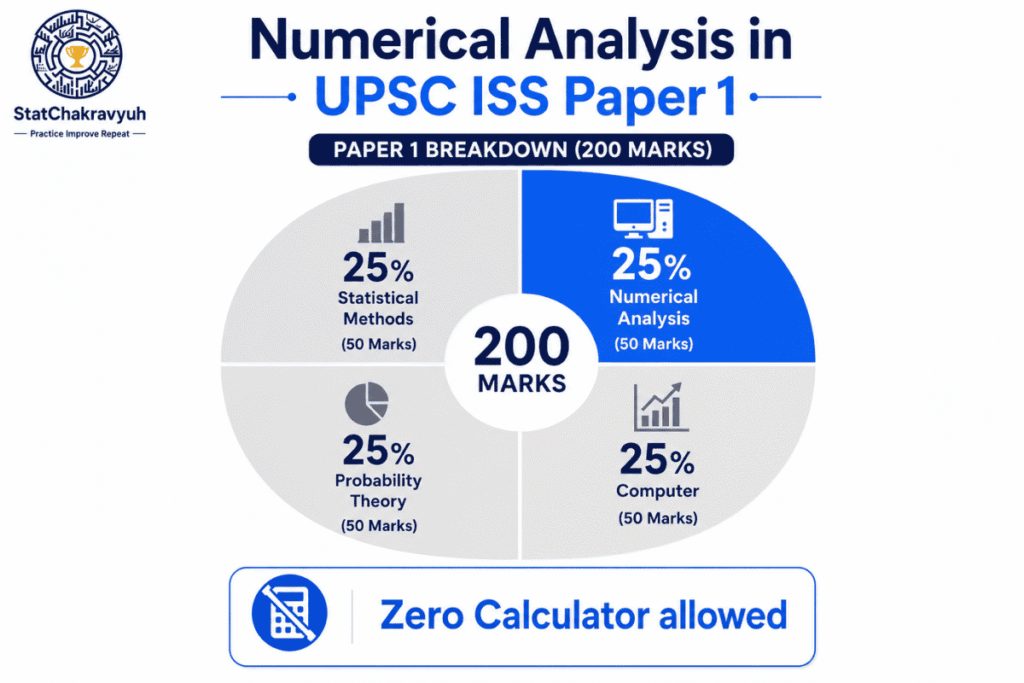
UPSC ISS Statistics Paper 1 contains 80 objective questions worth 200 marks total. Each question carries 2.5 marks and there is negative marking of one-third for every wrong answer. Time allowed: 2 hours.
Out of these 80 questions, UPSC ISS Numerical Analysis contributes approximately 25 questions. That is 62.5 marks, or 31.25% of your entire Paper 1 score. No other single unit comes close to this weightage.
Now layer the second constraint on top: scientific calculators are completely banned. The Commission expects you to solve every question using mental math, shortcuts, and conceptual reasoning alone.
This combination of high weightage plus calculator ban creates a unique situation. Numerical Analysis becomes either your biggest scoring asset or your biggest leak. There is no middle ground.
Here is the good news. Unlike Probability or Sampling Theory, where question patterns shift every year, Numerical Analysis is heavily formula-driven and pattern-driven. Once you master the operator properties, exactness rules, and error orders, you can solve almost any new question by recognizing the underlying pattern within 30 seconds.
This guide will train you in exactly that approach.
The Official Syllabus Breakdown
The official UPSC ISS syllabus for Numerical Analysis is dense and intimidating when read in raw form. We have decoded it into 8 clean modules covering every official topic. Here is the complete syllabus mapping:
Operators and Finite Differences: Operators E, Delta, Nabla, D. Their interrelations. Inverse operators. Factorial representation of polynomials. Differences of zero. Separation of symbols. Sub-division of intervals. Missing term techniques.
Interpolation with Equal Intervals: Newton-Gregory Forward and Backward interpolation formulas. Their derivations, error terms, and application conditions. When to use forward vs backward.
Central Difference Formulae: Gauss Forward, Gauss Backward, Stirling’s formula, Bessel’s formula. Use cases based on data position. Error analysis.
Unequal Intervals: Divided differences and their properties. Newton’s divided difference formula. Lagrange’s interpolation formula. Inverse interpolation techniques.
Numerical Differentiation: Differentiation using Newton’s Forward, Newton’s Backward, Stirling, and Bessel formulas. Practical computation of first and second derivatives.
Numerical Integration (Quadrature): General quadrature formula. Trapezoidal rule. Simpson’s 1/3 rule. Simpson’s 3/8 rule. Weddle’s rule. Euler-Maclaurin summation formula. Exactness degrees and error bounds for each method.
Summation of Series: Series where the general term is a first difference. Geometric series treatment using finite differences.
Difference Equations: Linear difference equations with constant coefficients. First order difference equations. Complementary functions and particular integrals.
Numerical Solution of ODEs: Picard’s method of successive approximations. Euler’s method and its local truncation error. Modified Euler’s method (Heun’s method). Runge-Kutta methods, especially RK-2 and RK-4. Local error vs global error distinctions.
Every single topic above is covered in our 35-blog series. No topic is skipped, no topic is treated lightly.
The Minimal Booklist (Just 2 Books)
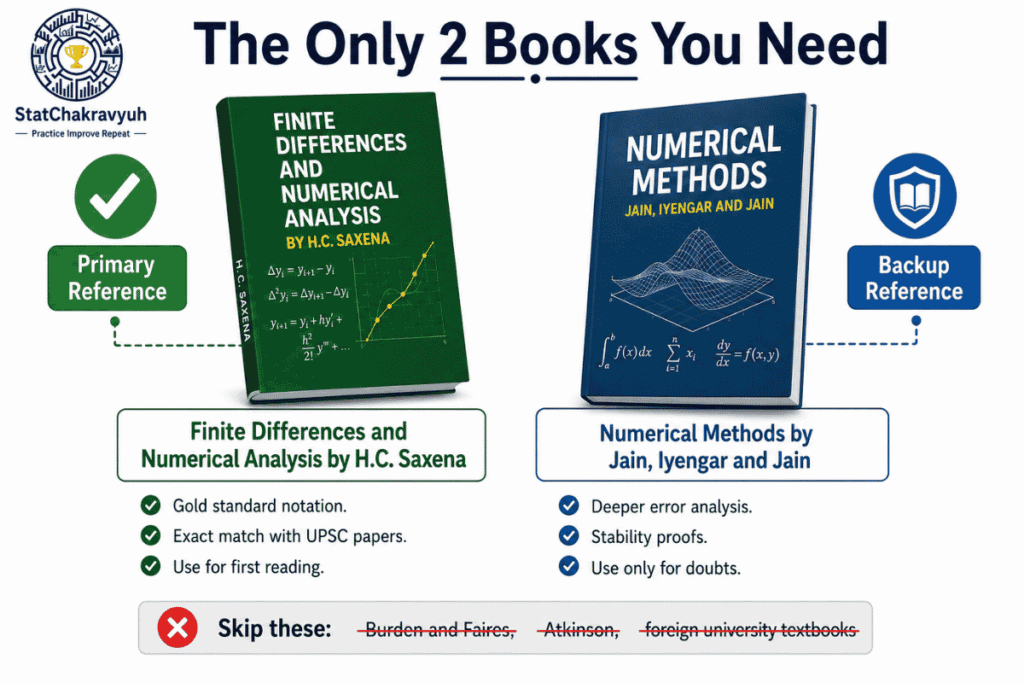
Most coaching institutes will push you to buy 5 to 7 books. Ignore that noise. For UPSC ISS Numerical Analysis, exactly two books cover everything you need.
Primary Reference: Finite Differences and Numerical Analysis by H.C. Saxena
Published by S. Chand. This is the gold standard. The notations used in actual UPSC ISS papers match this book exactly. Many PYQs are framed directly from its solved examples.
Use this book for: Reading concepts first time, building foundation, solving in-text examples, understanding operator properties.
How to use: Read one topic at a time. Solve every solved example without looking at the solution first. Make a separate notebook of just the formulas and their derivations.
Backup Reference: Numerical Methods by Jain, Iyengar, and Jain
Published by New Age International. More rigorous, more theoretical. Useful for going deeper when Saxena feels too brief.
Use this book for: Understanding error analysis in depth, stability conditions, theoretical proofs.
How to use: Do not start your preparation here. Use it as a clarification book when Saxena leaves a doubt unanswered.
What to avoid: Foreign authors like Burden and Faires, or Atkinson. They are excellent textbooks for university courses, but their notation and depth do not match UPSC requirements. Reading them wastes 6 months.
The 8 Module Learning System
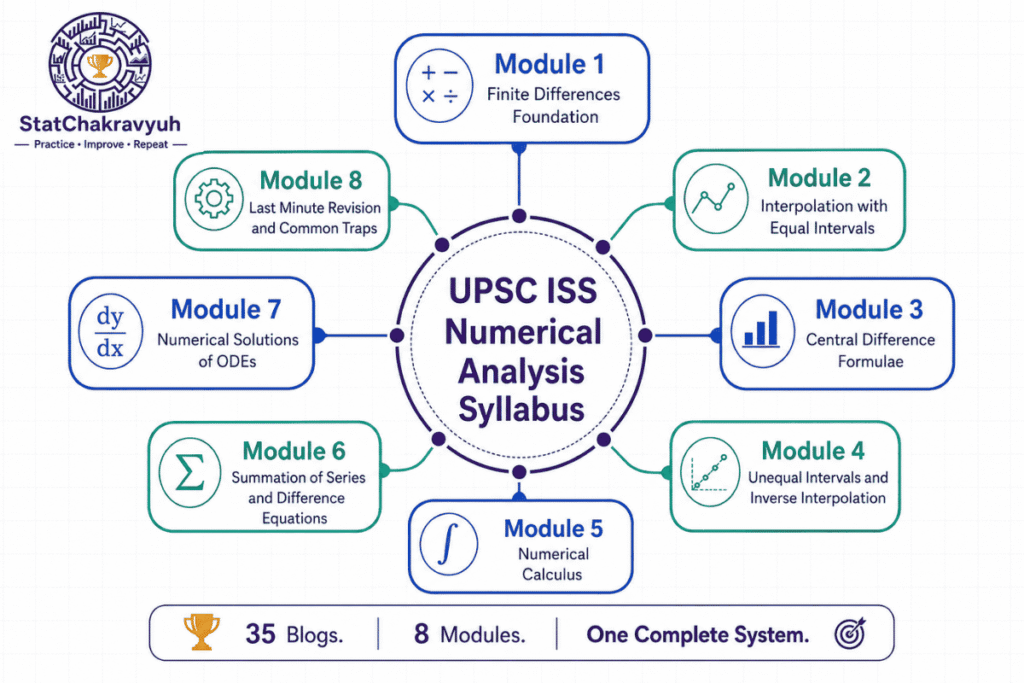
We have organized all 35 blogs into 8 progressive modules. Each module builds on the previous one. Follow them in order for first pass. Use them as random reference during revision.
Module 1: Finite Differences Foundation
This is the foundation of everything. You learn the language of Numerical Analysis here: operators, polynomials, factorial notation, separation of symbols, sub-division of intervals, and differences of zero. Without this module, none of the others will make sense.
Blogs in this module: 6 blogs covering basics of finite differences, operator algebra, separation of symbols, factorial representation, differences of zero, and intuitive concept of interpolation.
Time investment: 5 to 7 days
Explore Module 1: Finite Differences →
Module 2: Interpolation with Equal Intervals
The most directly tested topic in UPSC ISS. Newton’s Forward and Backward interpolation formulas appear in nearly every paper. You also learn how to handle missing terms and sub-divisions practically.
Blogs in this module: 3 blogs covering Newton-Gregory Forward, Newton-Gregory Backward, and Missing Terms with sub-divisions.
Time investment: 3 to 4 days
Explore Module 2: Interpolation Equal Intervals →
Module 3: Central Difference Formulae
When your target value lies in the middle of your data range, forward and backward formulas give large errors. This module solves that problem with Gauss, Stirling, and Bessel formulas.
Blogs in this module: 3 blogs covering Central Operators, Gauss Forward and Backward, and Stirling and Bessel formulas.
Time investment: 3 to 4 days
Explore Module 3: Central Differences →
Module 4: Unequal Intervals and Inverse Interpolation
Real data rarely comes in equal intervals. This module teaches you divided differences, Newton’s divided difference formula, Lagrange’s formula, and how to find x given y (inverse interpolation).
Blogs in this module: 4 blogs covering Divided Differences theory, Newton’s Divided Difference, Lagrange’s formula, and Inverse Interpolation.
Time investment: 4 to 5 days
Explore Module 4: Unequal Intervals →
Module 5: Numerical Calculus
The biggest scoring module. Numerical Differentiation and Numerical Integration together account for almost 8 to 10 questions per paper. Master the exactness degrees of Trapezoidal, Simpson’s 1/3, Simpson’s 3/8, Weddle’s rule, and Euler-Maclaurin summation, and you can solve most quadrature questions in under 30 seconds.
Blogs in this module: 6 blogs covering Numerical Differentiation, General Quadrature, Trapezoidal Rule with errors, Simpson’s 1/3 with derivation, Simpson’s 3/8 and Weddle’s, and Solving Quadrature PYQs.
Time investment: 7 to 10 days
Explore Module 5: Numerical Calculus →
Module 6: Summation of Series and Difference Equations
A lighter but high-yield module. Series summation using finite differences, and linear difference equations with constant coefficients. Direct formula application, easy marks.
Blogs in this module: 3 blogs covering First Order Difference Equations, Linear Difference Equations, and Euler-Maclaurin Summation Method.
Time investment: 3 to 4 days
Explore Module 6: Summation and Difference Equations →
Module 7: Numerical Solutions of Differential Equations
Picard’s method, Euler’s method, Modified Euler, and Runge-Kutta methods. The favorite trap zone of UPSC examiners. Local vs Global error distinctions are tested heavily. This module trains you to spot the trap before solving.
Blogs in this module: 4 blogs covering Picard’s Method, Euler’s Method with local error, Modified Euler’s Method, and Runge-Kutta methods with truncation errors.
Time investment: 5 to 7 days
Explore Module 7: Differential Equations →
Module 8: Last Minute Revision and Exam Strategy
The closer. One-page formula cheat sheet, exactness degree tables, common silly mistakes to avoid, identifying the right method in 5 seconds, and the top 25 most repeated PYQs solved in single-line shortcuts.
Blogs in this module: 5 blogs covering Ultimate Formula Cheat Sheet, Exactness and Error Bounds Summary, Common Silly Mistakes, Identifying the Right Formula Fast, and Top 25 Most Repeated PYQs.
Time investment: 3 to 4 days (use repeatedly during revision)
Explore Module 8: Last Minute Revision →
The Complete 35 Blog Library
Below is the master index of all 35 blogs published in this series. Each link opens a deep-dive blog with story, concept, shortcuts, solved PYQ, and FAQ.
Module 1: Foundation
- The Basics of Finite Differences
- Operator Algebra and Their Manipulations
- Separation of Symbols and Theorems
- Factorial Representation of Polynomials
- Differences of Zero and Delta Properties
- The Concept of Interpolation Explained
Module 2: Interpolation Equal Intervals
- Newton-Gregory Forward Interpolation
- Newton-Gregory Backward Interpolation
- Missing Terms and Sub-division of Intervals
Module 3: Central Differences
- Understanding Central Operators
- Gauss Forward and Backward Formulas
- Stirling and Bessel Formulas Compared
Module 4: Unequal Intervals and Inverse
- Divided Differences and Their Properties
- Newton’s Formula for Divided Differences
- Lagrange’s Interpolation Formula
- Inverse Interpolation Methods
Module 5: Numerical Calculus
- Basics of Numerical Differentiation
- General Quadrature Formula Derivation
- Trapezoidal Rule and Its Error Analysis
- Simpson’s 1/3 Rule and Its Derivation
- Simpson’s 3/8 Rule and Weddle’s Rule
- Solving Quadrature PYQs in Under a Minute
Module 6: Summation and Difference Equations
- First Order Difference Equations
- Linear Difference Equations
- Euler-Maclaurin Summation Method
Module 7: Differential Equations
- Picard’s Method of Successive Approximation
- Euler’s Method and Its Local Error
- Modified Euler’s Method (Heun’s Method)
- Runge-Kutta Methods and Truncation Errors
Module 8: Revision and Strategy
- The Ultimate Formula Cheat Sheet
- Exactness and Error Bounds Summary
- Common Silly Mistakes to Avoid
- Identifying the Right Formula Fast
- Top 25 Most Repeated PYQs
All 35 blogs follow the same battle-tested structure: a real-world story, the core concept simplified, StatChakravyuh Pro-Tips, a solved PYQ with shortcut, common traps to avoid, and an FAQ section.
Free Practice PDFs Library
Theory without practice is useless. After each module completes, we release a dedicated practice PDF with 40 to 50 MCQs and detailed solutions.
| Module | Contents | Status | |
|---|---|---|---|
| Module 1 PDF | Finite Differences | 50 MCQs with solutions, formula sheet, PYQ collection | Releases Sun July 5, 2026 |
| Module 2 PDF | Interpolation Equal | 50 MCQs with solutions, formula sheet, PYQ collection | Releases Sun July 12, 2026 |
| Module 3 PDF | Central Differences | 40 MCQs with solutions, formula sheet, PYQ collection | Releases Sun July 19, 2026 |
| Module 4 PDF | Unequal Intervals | 40 MCQs with solutions, formula sheet, PYQ collection | Releases Sun August 2, 2026 |
| Module 5 PDF | Numerical Calculus | 60 MCQs with solutions, formula sheet, PYQ collection | Releases Sun August 16, 2026 |
| Module 6 PDF | Summation Series | 30 MCQs with solutions, formula sheet, PYQ collection | Releases Sun August 23, 2026 |
| Module 7 PDF | Differential Equations | 60 MCQs with solutions, formula sheet, PYQ collection | Releases Sun August 30, 2026 |
| Module 8 PDF | Last Minute Revision | Top 100 PYQ mix, exactness tables, formula sheet | Releases Sun September 13, 2026 |
All PDFs are free for WhatsApp Community members. We send the download link directly to the community group whenever a new PDF goes live.
Join the WhatsApp Community to receive all PDFs →
The Zero Calculator Exam Strategy
UPSC ISS Paper 1 gives you 2 hours for 80 questions. That is 90 seconds per question. Without a calculator. Here is the strategy that works.
Strategy 1: Skip Then Solve
In the first 10 minutes, scan the entire Numerical Analysis section. Mark every question that asks for “order of error”, “exactness”, “Picard’s first approximation”, or “complementary function”. These are formula-recall questions that take 15 to 20 seconds each. Solve these first. They build a marks cushion.
Strategy 2: Operator Properties Over Tables
Instead of building difference tables for 5 minutes, memorize 10 operator identities and use them. Examples: Delta minus Nabla equals Delta times Nabla. E equals 1 plus Delta. These identities eliminate 70% of arithmetic.
Strategy 3: Exactness Hack for Integration
For any Numerical Integration question, first identify the polynomial degree of the integrand. Then match it to the exactness degree of available methods. If the integrand is degree 3 or less, Simpson’s 1/3 gives the exact answer. No calculation needed.
Strategy 4: Error Order Elimination
For RK-4 questions, the local error is O(h^5) and global error is O(h^4). Memorize these for all methods. When the question gives 4 options with different orders, you eliminate 3 instantly.
Strategy 5: Half Solve Detection
Many UPSC questions design wrong options that match a half-completed calculation. If your answer matches option B but you skipped one step, it is a trap. Always verify the order of magnitude.
Module 8 of this guide contains the complete exam day playbook with timing breakdown.
Solved Previous Year Questions
Every blog in this series includes at least one solved PYQ from actual UPSC ISS papers (2014 to 2025). Here is a quick taste of how we approach them.
Sample PYQ from UPSC ISS Paper 1:
A question asks for the value of a function at x = 1.5 using Newton’s Forward Interpolation, given data at x = 0, 1, 2, 3, 4. Most students will build the entire difference table (5 minutes). The shortcut approach: recognize that x = 1.5 is between the first two data points, so only the first three forward differences matter. Calculate those three values, plug into the formula, get the answer in 60 seconds.
This is the kind of thinking we train through 35 blogs and 8 practice PDFs. Theory is necessary. Shortcuts are decisive.
Common Mistakes to Avoid
Based on analyzing answer scripts of failed attempts, here are the seven most common mistakes UPSC ISS aspirants make in this section:
- Confusing local error with global error in RK methods.
- Using forward formula when target value is closer to the last data point.
- Forgetting that Simpson’s 1/3 requires even number of sub-intervals.
- Forgetting that Simpson’s 3/8 requires the number of sub-intervals to be a multiple of 3.
- Treating Picard’s first iteration as the final answer.
- Building full difference tables when only specific differences are needed.
- Ignoring the negative sign in backward differences during computation.
Module 8, Blog 32 (“Common Silly Mistakes”) covers each of these with worked examples and how to avoid them under exam pressure.
Frequently Asked Questions
-
How many days are enough to prepare Numerical Analysis from scratch?
For a serious aspirant studying 1 hour daily, 40 to 45 days are sufficient to cover all 8 modules with practice. Add another 15 days for two revision cycles, total 60 days.
-
Do I need calculus background to follow this guide?
You need basic Class 12 calculus (limits, differentiation, integration). No M.Sc. level calculus required. Every advanced concept is explained from scratch.
-
How do I download all 8 module PDFs?
Join our WhatsApp Community. Each PDF link is shared in the community on its release date (Sundays following each module completion). The links remain accessible permanently.
-
What if I find a topic too difficult even after reading the blog?
Comment on the specific blog with your exact doubt. We respond personally within 48 hours.
-
Is this guide sufficient or do I need a coaching course?
This guide plus the 8 practice PDFs plus active solving will cover 95% of what most coaching institutes teach for Numerical Analysis. If you need structured testing under exam conditions, our Complete Chakravyuh Test Series fills that gap.
-
How often is this page updated?
Every Sunday until September 2026, as new module pages and blogs go live. After that, twice yearly to incorporate new PYQs and reader feedback.
-
Can I share this page link with my study group?
Absolutely. The more aspirants who learn the right strategy, the higher the overall competitive bar. We encourage sharing.
Join the Community
If you have read this far, you are not a casual browser. You are serious about UPSC ISS 2027 or 2026.
Join Our UPSC ISS WhatsApp Community
Get all 8 practice PDFs delivered to you on release, daily one-line PYQ shortcuts, instant blog updates, doubt resolution from fellow aspirants, and direct access to the StatChakravyuh team. Free forever, no manual approval, instant access.
👉 Join the UPSC ISS WhatsApp Community
Explore the Complete Chakravyuh Test Series
If you want structured testing alongside this guide, our flagship test series gives you 350+ Daily Practice Papers, sectional tests, full-length mocks, and 3-day evaluation of descriptive copies by expert faculty.
👉 Explore the Complete Chakravyuh Test Series
Save This Page
This guide is updated continuously. Bookmark it now (Ctrl+D on desktop, Add to Home Screen on mobile). You will return here often during your preparation journey.
The path to clearing UPSC ISS 2027 starts with one decision: stop treating Numerical Analysis like a regular subject and start treating it like a high-yield, pattern-based scoring section. This guide is your map.
Practice Improve Repeat.