
IIT JAM MSGATE ST
StatChakravyuh Test Series Launch – A New Standard for IIT JAM and GATE Statistics Preparation
May 3, 2026
India’s most comprehensive GATE Statistics resource hub. This central platform offers integrated access to the official MS syllabus, topic-wise PYQs, and expert-curated booklists. Built around our unique 4-Phase Program, we provide a structured roadmap—from daily evaluation to full-length exam simulation—ensuring you build the conceptual depth and speed required for a top IIT rank.
Important Dates
Notification: Sep, 2026
Application Deadline: Oct, 2026
Admit Card Release: Jan, 2027
Exam Commencement: Feb 11, 2027
Result Declaration: Mar, 2027
Official Links
- Official Website
- 2025 Exam Brochure
- JOABS PORTAL
Communities & Support
- StatChakravyuh APP
- Telegram Channel
- WhatsApp Channel
- Support Mail ID
- WhatsApp Inquiry
Exam Syllabus
Access the detailed topic-wise breakdown for GATE Statistics (ST). Download our exclusive printable syllabus and integrated checklist to track your progress through Mathematics and Statistics modules effectively.
Coming SoonYear-wise PYQs
Access organized 7-year GATE ST previous papers, categorized by topics like Probability, Inference, and Real Analysis. Download official question papers with answer keys in PDF format for structured practice.
View DetailsBook-List
Master the ST syllabus with a curated list of standard reference books and topper-recommended resources. Get clear guidance on specific textbooks for Linear Algebra, Calculus, and Statistical Inference to build a strong foundation.
View Details4-Phase Program
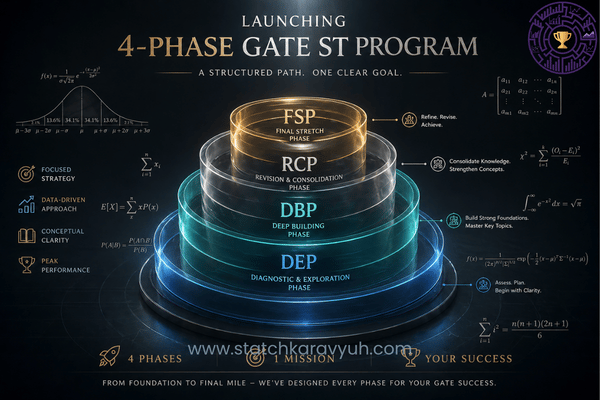
Experience our structured 4-phase preparation roadmap: Daily Evaluation (DEP), Daily Building (DBP), Revision & Concept (RCP), and Full-Length Simulation (FSP). Specifically designed to ensure consistency and exam-level speed.
Launch SoonSubject-Wise Study Guide
Probability Theory & Distributions
- Target: Master the foundation. This section forms the base for Inference. You should aim to be able to visualize distributions and their properties instantly.
- Strategy:
- Master the Basics: Start with the book Fundamentals of Mathematical Statistics (FMS) by Gupta & Kapoor. Focus deeply on Random Variables (PMF, PDF) and Expectations.
- Focus on Standard Distributions: thoroughly study standard distributions (Binomial, Poisson, Normal, Gamma, Beta). Don’t just memorize the PDF; understand their properties, assumptions, and how they relate to real-life scenarios.
- Practice Transformations: A critical part of the exam is “Transformation of Random Variables” (Jacobian method). Solve many problems where you have to find the distribution of Y given X
- Topper Tip: Create a “Chart Sheet” or “Cheat Sheet” and stick it on your wall. Write down the PDF/PMF, Mean, Variance, MGF, and inter-relations for every distribution. Revise this daily so it becomes muscle memory
Statistical Inference
- Target: This is the core of the exam. Your goal is to understand why we use a specific test or estimator, not just how to calculate it.
- Strategy:
- Standard Books: Use Prasanna Sahoo for basic exercises and Casella & Berger or Rohatgi for deeper concepts like Sufficiency, Completeness, and UMVUE.
- Estimation Techniques: Focus heavily on Maximum Likelihood Estimation (MLE) and Method of Moments. Understand the properties of estimators (Unbiasedness, Consistency).
- Hypothesis Testing: Master the Neyman-Pearson Lemma and Likelihood Ratio Test. Practice finding the Power of the Test and Type I/Type II errors, as these are frequently asked calculation-based questions
- Topper Tip: When solving Inference problems, try to understand the “Inter-relations” between distributions (e.g., how Chi-square relates to Normal). Many tough questions become easy if you know the properties rather than solving by integration
Linear Algebra & Matrices
- Target: Secure the “Rank-Maker” marks. This section carries about 30% weightage. Many Statistics students ignore this, so scoring here gives you a massive advantage.
- Strategy:
- Focus on High-Yield Topics: Prioritize Matrices, Rank, Determinants, Systems of Linear Equations, and Eigenvalues/Eigenvectors. These are standard and scoring topics.
- Visualization: For Linear Algebra, books like Friedberg or Hadley can help with analytical thinking, but for JAM, focus on solving numerical problems accurately.
- Practice Calculations: Linear Algebra questions can be calculation-heavy. Practice solving them quickly without making silly arithmetic errors.
- Topper Tip: Do not ignore Math. Even if you are from a Stats background, Linear Algebra and Sequences are purely property-based. If you know the property (e.g., properties of Rank or Eigenvalues), you can solve questions in seconds
Calculus
- Target: Handle the “Tools” of Statistics. You cannot solve joint probability questions without strong integration skills.
- Strategy:
- Refresh 11th & 12th Basics: Many students fail because they forget basic graphs (Parabola, Ellipse) or basic integration techniques. Spend 15 days revising high school calculus if needed.
- Real Analysis: For Sequences and Series, use the book S.K. Mapa. Focus on convergence tests (Ratio test, Root test) and properties of sequences (Monotonicity, Boundedness).
- Multiple Integrals: Practice Double and Triple integrals thoroughly. This is directly applied when finding marginal and conditional PDFs in Statistics.
- Topper Tip: Be careful with Modulus functions and Inequalities. Many students lose marks because they don’t know how to open a modulus function correctly in an integration limit. Clear your basic calculus concepts first.
Your Path to Success (GATE Statistics 2027)
Diagnostic Entry Program (DEP)
THE BENCHMARK
We test your current speed and conceptual clarity. This stage identifies if you are struggling with Formula Application or Calculation Errors.
Attempt NowDiscipline Builder Program (DBP)
CONSISTENCY
JAM preparation requires daily practice. This stage gives you daily topic-wise targets to ensure you finish the syllabus with high accuracy.
Take the ChallengeRank Conditioning Program (RCP)
AGILITY TRAINING
We stop topic-wise spoon-feeding. You get mixed-bag tests (e.g., Inference + Probability). This trains your brain to switch contexts instantly like in the real exam.
Enroll in Test SeriesFinal Simulation Program (FSP)
THE PRESSURE COOKER
Full syllabus mocks. 60 Questions. 180 Minutes. Same interface. We simulate the exact exam pressure to eliminate D-Day panic.
View ScheduleLatest GATE Statistics Blog
More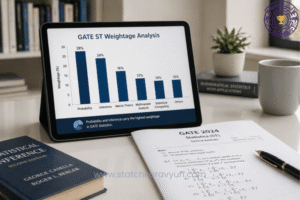
GATE Statistics PYQ Analysis – Weightage Patterns, Scoring Zones, and Smart Preparation
Shyam Agrawal
May 2, 2026
GATE Statistics (ST) is a relatively recent addition to the GATE family, which means the pool of Previous Year Questions…

GATE Statistics Preparation Strategy – How to Score 60+ and Secure a Top Rank
Shyam Agrawal
April 30, 2026
GATE Statistics (ST) is a paper that rewards systematic preparation. Unlike some GATE engineering papers where the competition pool is…
Best Books for GATE Statistics (ST) – A Complete Topic-Wise Guide for 2027
Shyam Agrawal
April 21, 2026
GATE Statistics (ST) has quickly become one of the most important exams for B.Sc. and M.Sc. Statistics graduates who want…

IIT JAM MS vs GATE ST vs GATE DA – Which Exam Should You Choose?
Shyam Agrawal
April 17, 2026
If you are a B.Sc. Statistics student planning your next step, you have probably come across three major exams: IIT…

Scope of GATE Statistics – Is It Worth It in 2027?
Shyam Agrawal
April 15, 2026
GATE Statistics (ST) is one of the newer papers introduced in the Graduate Aptitude Test in Engineering, and there is…