

If you are preparing for the UPSC Indian Statistical Service (ISS) exam, especially Objective Paper 2, you have likely hit a wall that every serious aspirant faces. You go to the market looking for a standard textbook on Official Statistics, specifically focusing on UPSC ISS Official Statistics, and you find… nothing.
The reality? A perfect book for Official Statistics does not exist.
Unlike Inference or Linear Models, this subject is dynamic. It changes every year. relying on a “Senior’s Note” from 2020 for the 2026 exam is a recipe for disaster. Methodologies evolve, base years change, and agencies merge.
So, how do you score marks in a section that has no textbook?
UPSC ISS Topper Rank 12 noted that this is the only section where you can score 100% accuracy if you are updated.
Today, I am sharing the exact roadmap used by toppers to master this section using the “Source of Truth.”
The Solution: The 4-Pillar Strategy
Since you cannot rely on a single book, you must build your own dynamic study material using these four sources:
1. The Holy Grail: Official Websites
Your primary source is the government itself. Do not trust third-party PDFs blindly.
- MoSPI (Ministry of Statistics and Programme Implementation): This is your Bible. Visit mospi.gov.in/about-us. Go to the “About Us” and “Divisions” sections. Read the specific functions of the NSO, NAD, and FOD.
- Labour Bureau: Visit labourbureau.gov.in. This is crucial for indices like CPI-IW and CPI-AL/RL.
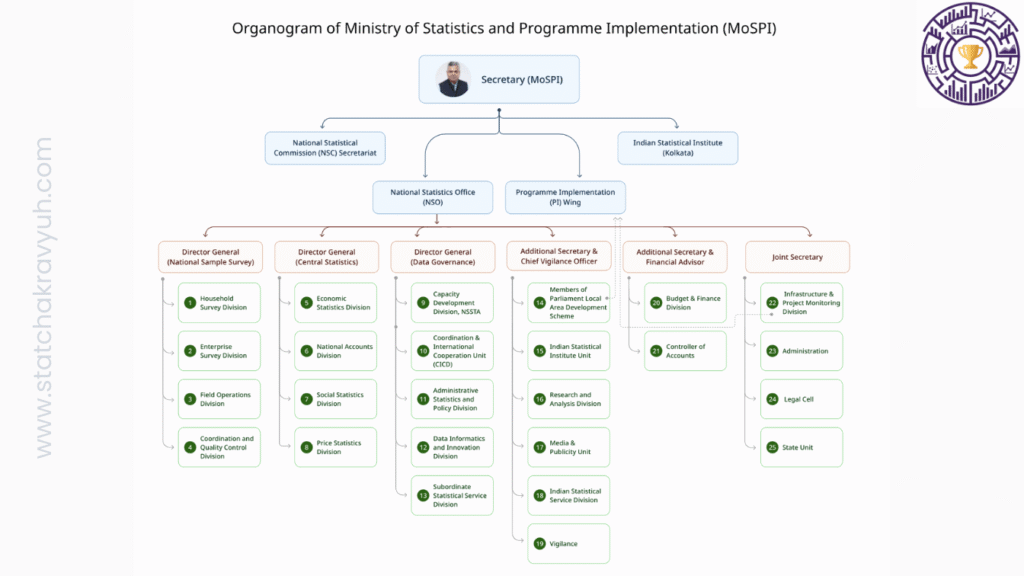
Image Source: MoSPI Official website
2. Wikipedia (For History & Definitions)
For static concepts, Wikipedia is excellent for quick timelines.
- Use it to find the History of the Census (e.g., When was the first synchronous census?).
- Use it for definitions of key committees (like the Rangarajan Commission).
3. Use AI Smartly (But Verify!)
Stuck on a confusing concept? AI tools can be great tutors.
- Prompt Example: “Explain the difference between CPI and WPI baskets in simple terms.”
- ⚠️ WARNING: AI can hallucinate numbers. Always verify the Base Year and current data from the official government website.
4. Topper Notes (When You Are Stuck)
If the official legal language is too hard to understand, you can refer to topper notes for structure.
- Recommendation: AIR 1 2022 Topper Astitva Ranjan Notes are a great starting point to understand the “skeleton” of the subject. Notes Link
- Disclaimer: These notes might be older. Use them for understanding, but verify every single formula, base year, and agency from the live MoSPI website.
Quick Reference: Who Releases What?
To save you time, here is a snapshot of the agencies you must memorize. If you see a question on these, it should be “free marks” for you.
| Indicator | Agency | Frequency | Base Year |
| GDP (National Accounts) | NSO (NAD) | Quarterly/Annual | 2022-23 |
| CPI (Combined) | NSO | Monthly | 2024 |
| CPI (Industrial Workers) | Labour Bureau | Monthly | 2016 |
| WPI (Wholesale Price) | Office of Economic Adviser (DPIIT) | Monthly | 2011-12 |
| IIP (Industrial Production) | NSO (ESD) | Monthly | 2022-23 |
| Population Census | Registrar General of India (MHA) | Decennial | 2011 (latest) |
(Note: Always verify current data closer to your exam date as new press releases come out ).
High-Yield Topics: Focus Your Energy Here
Official Statistics is vast. Don’t try to read everything. Focus on these “Hot Topics” that appear in the exam frequently:
1. National Accounts (GDP)
- Sectors & Components: Deeply understand the three approaches (Income, Expenditure, Production) and how different sectors contribute.
- GVA vs. GDP: Know the formula linking them:
GDP = GVA + Product Taxes – Product Subsidies.
2. Index Numbers (The Most Critical Section)
- The Big Three: CPI, WPI, and IIP.
- Base Year: This is crucial. Since base years are a hot topic of discussion, this is a potential exam question.
- Note: I have already covered the Base Year updates in detail. Check out my 3-Blog Series on Base Year Updates Here
- Weightage: Memorize the weightage of major commodity groups (e.g., Manufacturing in IIP, Food in CPI).
- Splicing: How do you join two index series with different base years? This concept is vital for trend analysis and is a favorite for the Interview
3. System Structure
- Hierarchy of MoSPI.
- Role of the National Statistical Commission (NSC).
- The difference between the old CSO/NSSO and the current NSO structure.
4. Surveys & Employment Statistics
- PLFS (Periodic Labour Force Survey): Understand the key metrics—UR (Unemployment Rate), LFPR (Labour Force Participation Rate), and EPR (Employment-Population Ratio).
- Know the difference between Current Weekly Status (CWS) and Usual Status (US).
5. Agriculture Statistics
- Agricultural Census: Conducted every 5 years; unit is “Operational Holding”.
- Livestock Census: Conducted every 5 years.
6. NSSO Rounds
Keep an eye on the latest NSSO rounds. Know the Round Number and the Subject/Theme (e.g., Housing Condition, Domestic Tourism).
Understanding UPSC ISS Official Statistics can significantly boost your preparation.
Want Me to Cover the Whole Syllabus?
Reading all these websites and reports can be boring, confusing, and time-consuming. You might be thinking, “Shyam, can you just teach this to us systematically?”
Here is the deal:
I am ready to create a dedicated “Official Statistics Blog Series” where I will cover:
- Deep Dives: The complete breakdown of every topic mentioned above.
- Mock Questions: PYQs and expected questions for each topic.
- Interview Prep: The “Why” behind the data (e.g., “Why hasn’t the base year changed?”).
But I need to know if you guys actually need this effort.
Message me: “I want Official Stats Blog Series”.
If I get 25+ responses, I will start this series immediately to cover the whole syllabus properly from scratch.
Let’s crack ISS together!
This article is part of our complete guide to Official Statistics for UPSC ISS. Bookmark the main guide for the full roadmap.
[…] my last blog post, I included a small note at the end. I simply asked: “Do you want me to cover the UPSC […]