
In our last blog, we discussed the “Big Picture” of MoSPI’s base year revisions. Today, we are zooming in on the indicator that affects every Indian’s pocket and every UPSC ISS aspirant’s marks: The Consumer Price Index (CPI).
The government is shifting the CPI Base Year from 2012 to 2024.
Why is this huge? Because the current inflation data assumes you are still living in 2012—buying DVDs, using 2G data, and spending nearly half your income on food. The reality of 2024 is very different, and this change will rewrite the rules of General Economics and Applied Statistics papers.
Here is your deep dive into the “New CPI,” simplified for the ISS exam.
The Problem: The “Expired” Basket of 2012
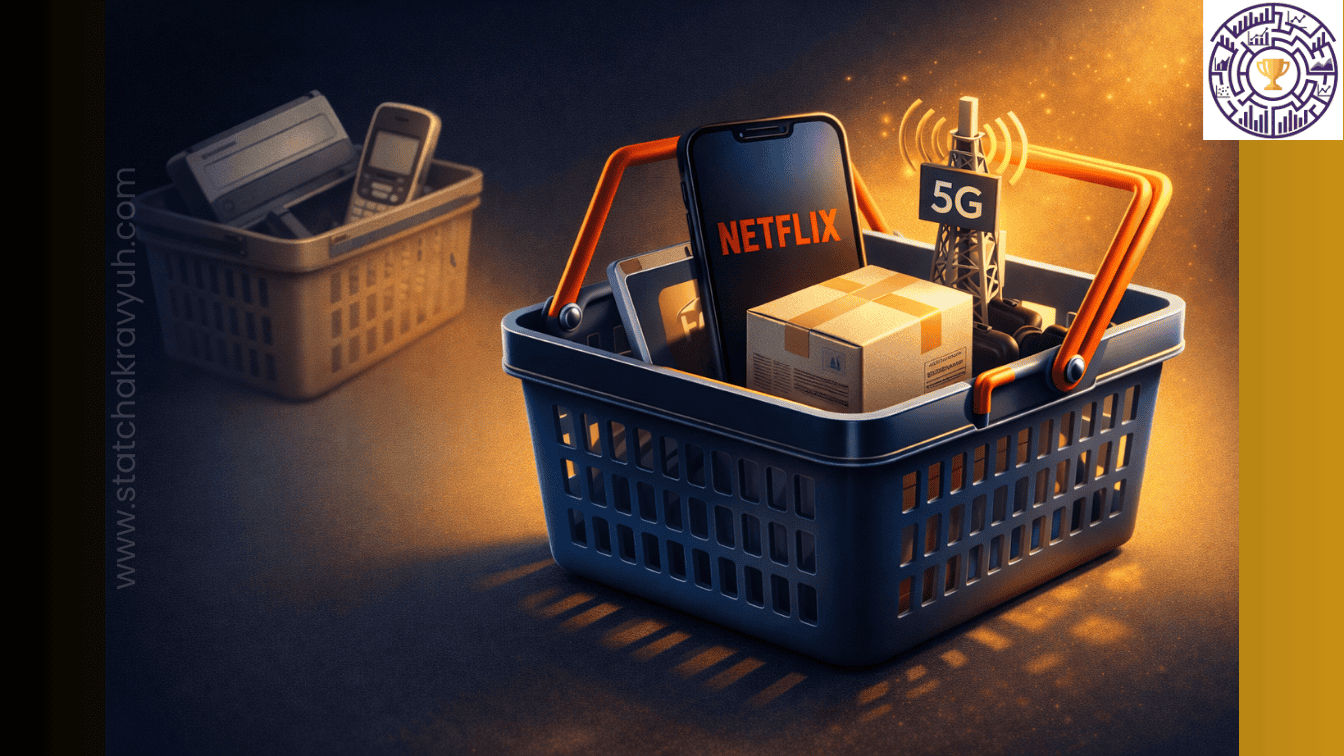
Imagine calculating your monthly budget today using a list from 12 years ago.
- Old Basket (2012): Tracks prices of items like “VCR/DVD players” and “Nokia feature phones.”
- Missing Items: It misses modern essentials like OTT Subscriptions (Netflix/Hotstar), 4G/5G Data Packs, and Smartphone repairs.
Because of this, the RBI (Reserve Bank of India) has been fighting inflation with a “broken compass.” They might be raising interest rates based on the price of items no one buys anymore!
The Fix: What Changes in the 2024 Series?
MoSPI, guided by the Ashish Kumar Committee, is fixing this using data from the fresh Household Consumption Expenditure Survey (HCES) 2022-23.
The “Engel’s Law” Effect (Less Food, More Fun)
This is a potential Interview Question.
- Concept: As people get richer, they spend a smaller percentage of their income on food, even if they eat better. This is called Engel’s Law.
- The Shift: In 2012, the weight of “Food & Beverages” in CPI was 45.86%. In the 2024 series, this weight is expected to drop significantly.
- Impact: Food prices (tomatoes, onions) go up and down wildly due to rain. If the food weight drops, India’s “Headline Inflation” will become more stable and less volatile.
Enter the Digital Economy
For the first time, the CPI will officially track the “Digital Cost of Living.”
- New Items: Internet tariffs, online coaching fees, and subscription services.
- Web Scraping: Instead of just visiting shops, data collectors will now “scrape” prices from e-commerce sites like Amazon and BigBasket to get real-time online prices for electronics and clothes.
The “Free Food” Dilemma (PDS)
This is a tricky Paper III (Applied Stats) concept. Over 80 crore Indians get free grain under PMGKAY.
- The Problem: If the price of rice is Zero for them, should CPI record it as Zero? If we do, inflation might look artificially low.
- The Solution: The committee is considering Method 1 (Imputation) from the CPI Manual—adjusting weights to reflect that while the price is zero, the value of consumption still exists.
ISS Aspirant Corner: The Technical Stuff
In the exam, you won’t just be asked “What changed?”; you will be asked to solve it.
The “Splicing” Challenge
When the base year changes from 2012 to 2024, you cannot compare the index numbers directly. You need to “link” or “splice” the two series.
- Formula: Splicing Factor = (Index of New Base Year / Index of Old Base Year) * 100
- You must know how to convert the old series into the new one using the Arithmetic Mean method.
Deflator vs. CPI
A common question in General Economics: Why doesn’t the GDP Deflator match the CPI?
- New CPI (2024) will track consumption (what we buy).
- New WPI (likely 2017-18 or later) tracks production (what factories make).
- The divergence between these two is often a 15-mark subjective question!
Source Link: mospi.gov.in
Conclusion: The Takeaway
The new CPI Base Year (2024) is good news for the economy—it’s more accurate and modern. But for you, the aspirant, it means new weights, new item baskets, and new calculation methods to learn.
Key Stats to Remember:
- New Base Year: 2024
- Data Source: HCES 2022-23 & 2023-24
- Committee Chair: Ashish Kumar
- Major Change: Lower weight for Food; inclusion of Digital Services.
But what about the hidden informal economy? Read Part 3 here.
Share this with your study circle and keep calculating!
[…] Want to know how Inflation is calculated? Read Part 2 here. […]
[…] the previous parts of our Decoding Base Year series, we tackled the Overview and the New CPI. Today, we are opening the “Black Box” of Indian GDP: The Unorganized (Informal) […]