

If you are preparing for the UPSC Indian Statistical Service (ISS) exam, you know that “Official Statistics” (Paper II) and “General Economics” are the rank-deciders. But here is the challenge: the textbooks are old, but the economy is changing fast.
The Ministry of Statistics and Programme Implementation (MoSPI) is currently undertaking one of the most massive exercises in Indian history shifting the Base Year for our economic indicators.
Why does this matter for you? Because for the ISS 2026 exam, the question paper won’t just ask “What is GDP?”; it will ask “Why was 2022-23 chosen as the new base?” or “How does Double Deflation improve GVA estimates?”.
In this blog, we break down everything from the basic concepts to the expert-level debates—simplifying the “New Base Year” saga for every StatChakravyuh aspirant.
🟢 Level 1: The Basics (For Beginners)
What is a “Base Year” and Why Change It?
Imagine measuring your height. You need a mark on the wall to compare against. In economics, that mark is the Base Year. It is a reference point used to compare the “real” growth of the economy, stripping away the effects of inflation (price rise).
Currently, India uses 2011-12 as the base year for GDP and IIP.
- The Problem: The world of 2011 didn’t have widespread 4G, UPI payments, or a massive Gig economy. By using an old base, we are measuring a “smartphone economy” with a “landline ruler.”
- The Solution: MoSPI is updating this ruler to capture the modern structure of the economy—like the rise of digital services and high-tech manufacturing.
🟡 Level 2: The Big Changes (The “Must-Know” Facts)
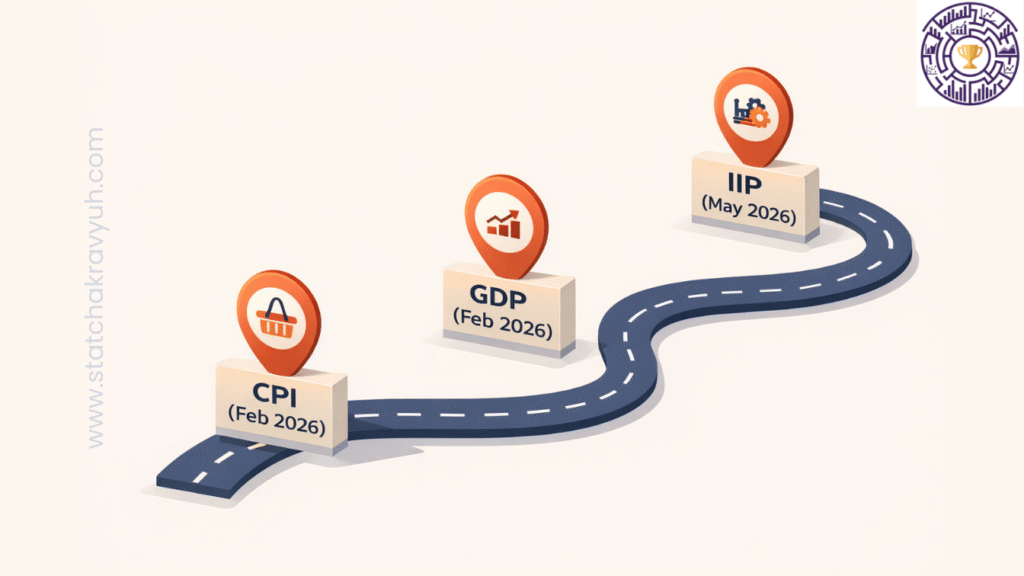
MoSPI has released a roadmap for the new series, targeting a release in early 2026. Here is the snapshot you need to memorize for your objective papers:
| New Base Year | Current Base | New Base Year | Expected Release | Key Committee |
|---|---|---|---|---|
| GDP | 2011-12 | 2022-23 | Feb 27, 2026 | ACNAS, (Chair: Prof. B.N. Goldar) |
| CPI | 2012 | 2024 | Feb 12, 2026 | Expert Group (Chair: Ashish Kumar) |
| IIP | 2011-12 | 2022-23 | May 28, 2026 | TAC on IIP |
Why 2022-23?
You might ask, “Why not 2020 or 2021?” The answer is Stability.
- 2020-21: Was the COVID lockdown year (GDP contracted). A low base would make future growth look artificially high.
- 2021-22: Was a volatile “recovery” year.
- 2022-23: Considered the first “normal” year post-pandemic, making it the perfect anchor.
🔴 Level 3: The “Game Changer” Concepts (For Paper II & III)
This is where the ISS exam separates the toppers from the crowd. The revision isn’t just about changing a date; it’s about changing the methodology.
1. The Shift to “Double Deflation” in GDP
Currently, India uses “Single Deflation”—we just adjust the output value for inflation.
2. Direct Estimation of the “Unorganized Sector”
Previously, we assumed the informal sector (small shops, dhobis) grew at the same rate as big corporates. This was a disaster during shocks like Demonetization or COVID.
3. A “Smart” CPI Basket
The CPI basket is getting a makeover based on the Household Consumption Expenditure Survey (HCES) 2022-23.
⚫ Level 4: Advanced Analysis (Critical Thinking)
For your General Studies (Paper II) and Essay, you need to critique the move. Here are the “Brownie Point” arguments:
1. The “Census Deficit” Problem
Usually, a base year revision follows a Census (Population count). But Census 2021 is delayed. Experts like Pronab Sen argue that without accurate population data, the “multipliers” used to blow up survey data (like HCES) might be wrong, potentially undercounting the urban poor.
2. The “K-Shaped” Debate
Did the informal sector really recover? By moving to a 2022-23 base, some economists fear we might “mask” the scars of the pandemic. If the base year itself is a year of inequality (K-shaped recovery), future growth might look rosy while hiding ground-level distress.
3. The IMF “C” Grade
The International Monetary Fund (IMF) recently gave India a “C” grade for some data practices, citing the outdated base year. This 2026 revision is India’s direct answer to improve that global credibility.
Source Link: mospi.gov.in
Summary Checklist for Aspirants
Before you close this tab, make sure you can answer these 3 questions:
Answer: Double Deflation
Answer: Double Deflation
Answer: HCES 2022-23
Found this helpful? Share this with your ISS study group! And if you are serious about cracking the exam, don’t rely on outdated materials. Upgrade your prep with StatChakravyuh.
Want to know how Inflation is calculated? Read Part 2 here.
[…] our last blog, we discussed the “Big Picture” of MoSPI’s base year revisions. Today, we are […]
[…] the previous parts of our Decoding Base Year series, we tackled the Overview and the New CPI. Today, we are opening the “Black Box” of Indian GDP: The […]