

As a Statistics student in India, you might feel uncertain. You have a powerful degree, but where is the perfect job for you? General government exams are crowded, and private jobs often don’t use your core skills.
Stop wondering. The answer is the UPSC Indian Statistical Service (ISS).
This is not just “another government job.” It is a specialist service where you don’t just follow orders you define national policy using data. You become a Group ‘A’ Gazetted Officer.
In this guide, we will decode the entire UPSC ISS 2026 process using the 4W-1H Framework and reveal Hidden Patterns that most students miss.
What – The Identity
What is UPSC ISS?
The Indian Statistical Service (ISS) is an elite Group ‘A’ Central Service conducted by the UPSC.
When you crack this exam, you join the Ministry of Statistics and Programme Implementation. You sit at the nerve center of India’s data machinery. From calculating the GDP to managing the National Census, you are the expert behind the numbers.
Pro Tip: In other civil services (like IAS), your specific degree might not matter. But in ISS, your knowledge of Statistics is your superpower. You are respected as a Subject Matter Expert from Day 1.
Why – The Motivation (ROI)
Why Should You Apply?
The Return on Investment (ROI) for this exam is incredible.
- Low Cost, High Reward: The application fee is just ₹200. Even better, there is ZERO Fee for Female, SC, ST, and PwBD candidates.
- Salary & Perks: You start with a salary of approx. ₹85,000 – ₹1,00,000+ per month along with government accommodation, medical facilities, and immense job security.
- Impact: You directly contribute to nation-building.
- Work-Life Balance: Compared to corporate data science jobs, ISS offers a balanced life with fixed working hours.
Who – The Eligibility Filter
Are You Eligible?
Eligibility is the first gate. Read this carefully to avoid rejection.
- Nationality: You must be a Citizen of India.
- Age Limit:
- General: 21 to 30 Years.
- OBC: Up to 33 Years.
- SC/ST: Up to 35 Years.
- Educational Qualification:
- For Bachelor’s Degree: You need Statistics / Mathematical Statistics / Applied Statistics as one of the main subjects.
- For Master’s Degree: You need a degree in Statistics / Mathematical Statistics / Applied Statistics.
- ⚠️ Crucial Warning: If you are applying based on your Bachelor’s degree, Statistics must be a subject in ALL THREE YEARS of your graduation. Many students get disqualified because they studied Statistics only for 2 years. Check your marksheets now!
When – The Timeline
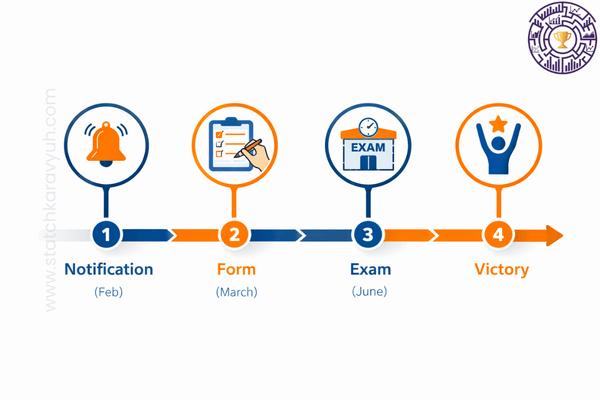
Important Dates for 2026
UPSC is very strict with its calendar. For the 2026 cycle, mark these dates in red:
- Notification Date: 11th February 2026 (Forms will open).
- Last Date to Apply: First week of March 2026.
- Exam Date: 19th June 2026 (Friday).
- Result (Written): Expected in September/October 2026.
Pro Tip (Center Selection): Exam centers are allotted on a “First-Apply-First-Allot” basis. If you want a center near your home (other than major hubs like Delhi/Chennai), fill out the form on the first day itself. Don’t wait!
Verdict: The notification comes on Feb 11, 2026. You have limited time left. Start now!
How – The Roadmap
Exam Pattern & Resources
The exam has two parts: Written (1000 Marks) and Interview (200 Marks).
| Paper | Subject | Marks | Duration | Type |
|---|---|---|---|---|
| 1 | General English | 100 | 3 hrs | Subjective |
| 2 | General Studies | 100 | 3 hrs | Subjective |
| 3 | Statistics-I | 200 | 2 hrs | Objective (MCQ) |
| 4 | Statistics-II | 200 | 2 hrs | Objective (MCQ) |
| 5 | Statistics-III | 200 | 3 hrs | Descriptive |
| 6 | Statistics-IV | 200 | 3 hrs | Descriptive |
Vital Rules You Must Know:
The Calculator Rule:
- Allowed: Scientific (Non-Programmable) calculators are allowed in Paper III & IV (Descriptive).
- Banned: You CANNOT use a calculator in Paper I & II (Objective). You must practice mental math for these papers.
The Paper IV Strategy:
- Paper IV has 7 sections, but you only have to attempt TWO sections.
- Strategy: Don’t study everything. Pick your 2 strongest topics (e.g., Demography & Multivariate Analysis) and master them.
📥 Download Previous Year Papers (PYQs)
Understanding the pattern is not enough; you need to see it. If you haven’t analyzed the actual papers yet, download them now. 👉 Click Here to Download UPSC ISS Previous Year Question Papers PDF
The Solution: StatChakravyuh Test Series (LIVE Now)
You cannot crack ISS just by reading books. You need practice. Our UPSC ISS 2026 Test Series is already running and helping students improve daily.
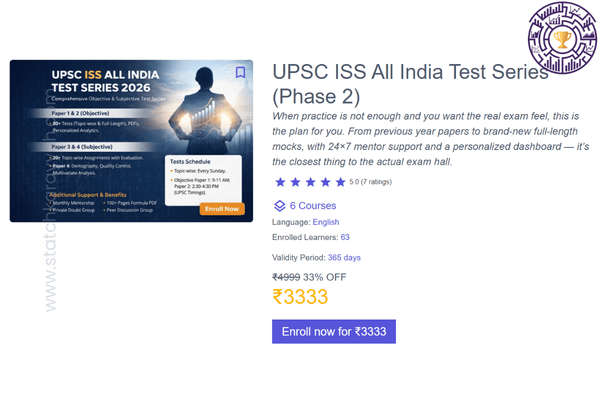
Why Join StatChakravyuh Test Series?
- Real Exam Pattern: Questions designed exactly like the actual UPSC paper.
- Quality & Quantity: Cover whole UPSC ISS syllabus of all 4 statistics Paper (Both Objective and Descriptive).
- Performance Analysis: Know your weak areas before the exam.
- Affordable: Best quality content at student-friendly prices.
⚠️ The Hidden Patterns (Insider Analysis)

The official notification contains hidden warnings that can save your career.
The “Mistake Pattern” (Avoid These Errors)
- OTR Profile: Your Name, Date of Birth, and Parents’ names in the One-Time Registration (OTR) cannot be changed easily. Be 100% accurate.
- Photo Rule: Your photo must not be older than 10 days from the notification date. It must have your Name and Date of Photo printed on it clearly.
- Category Lock: Once you select a category (UR/OBC/SC), you cannot change it later. A mistake here is final.
The “Question Pattern”
- Speed is King: In Papers I & II, you have 120 minutes for 80 questions. That is 90 seconds per question. If you get stuck on one hard question, you lose.
- Compulsory Questions: In Descriptive papers, 50% of questions are Short Answers and 50% are Long Answers. The notification says specific questions from each section are compulsory. You cannot skip them.
The “Ideal Aspirant”
UPSC is not looking for a “Bookworm.” In the interview, they look for Intellectual Curiosity and Leadership. They want a future leader, not just a calculator.
💡 Read More:
These are just the basics. We have compiled a detailed list of common errors that stop students from getting selected. 🔗 The Hard Truth: Why Most UPSC ISS Aspirants Fail
Conclusion
The journey to becoming a UPSC ISS officer is a marathon, not a sprint. It demands dedication, but the reward is a career where you build the nation.
You have the degree. You have the talent. Now you have the roadmap. The notification arrives on Feb 11, 2026. Are you ready?
All the best!
Frequently Asked Questions (FAQs) regarding UPSC ISS 2026
Can final year students apply for UPSC ISS 2026?
Yes, final year students are eligible to apply. However, you must submit proof of passing the required degree (Detailed Application Form) before the deadline mentioned in the official notification (usually after the written result).
Is a calculator allowed in the UPSC ISS Exam?
There is a specific rule.
Paper I & II (Objective): No, calculators are strictly prohibited.
Paper III & IV (Descriptive): Yes, you are allowed to use a Scientific (Non-Programmable) calculator.
Tip: Practice manual calculations for the first two papers to improve speed.
Is it mandatory to have Statistics in all 3 years of Graduation?
Yes, this is the most critical eligibility rule. If you are applying based on a Bachelor’s degree, you must have studied Statistics / Mathematical Statistics / Applied Statistics as a subject in all three years of your course.
Can I change my Exam Center after submitting the form?
No, UPSC does not allow changing the exam center once the form is submitted. Centers are allotted on a “First-Apply-First-Allot” basis, so fill out your form on the very first day to get your preferred city.
Is coaching necessary to crack UPSC ISS?
While self-study is possible, the syllabus is vast. A structured test series (like StatChakravyuh) helps you understand the question pattern and manage time effectively, which is often the deciding factor between selection and rejection.
[…] If you want a full overview of the exam pattern, marks, and syllabus, see our UPSC ISS 2026 complete guide. […]